Burn Blue: What the Water Remembers
/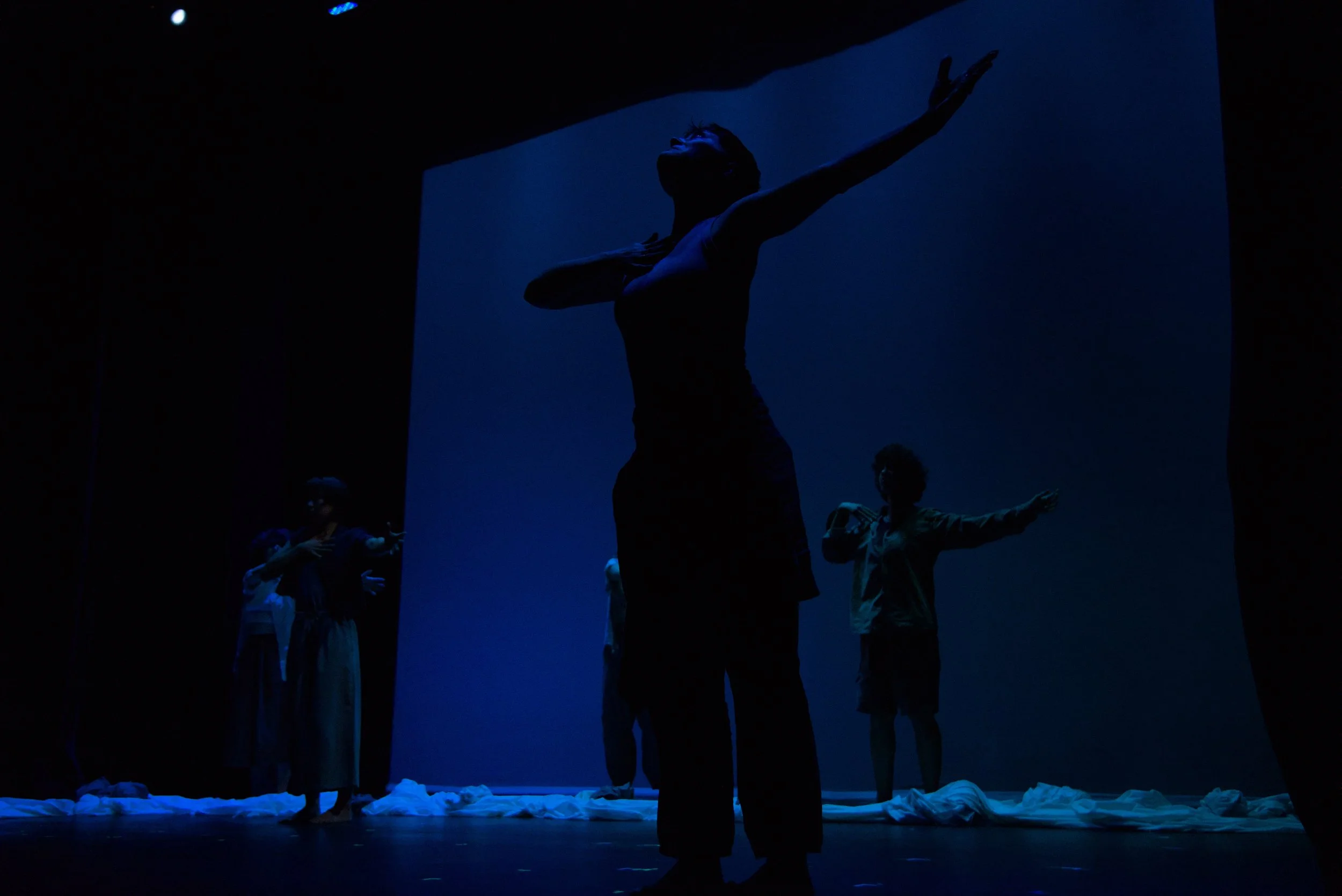
I can’t swim. Still, I’ve always felt the pull of water, joining friends at lakes, beaches and pools, careful not to fall and sink. Watching Burn Blue, I found myself thinking about what it means to be held by something we cannot hold ourselves. Through personal stories, movement and music, the performance explores water as memory, lifeline and witness to the ways we shape, and reshape the land. It left me thinking about the stories water carries, and how easily we forget our place within them.
In Burn Blue, water is a witness to history, of land and humans alike. It becomes a source of comfort, a site of destruction and a reminder of what happens when we try to control nature.
Originally conceived in 2021 by artists Jill Goranson and Kelsi James, Burn Blue was meant to be a collection of songs celebrating the ocean. When the pandemic interrupted the project, the work was put on hold. Five years later, Jill and Kelsi returned to it with a new vision, bringing together a collective of seven artists from different disciplines and cultural backgrounds to create something entirely new.
Presented at the 2026 Vancouver Fringe Festival, Burn Blue is a multidisciplinary performance that weaves together music, contemporary dance, poetry, storytelling, puppetry and projected archival footage. The performers explore their relationships with water and the places they call home. The audience travels from the shores of Iran to the waters of Taiwan, through Vancouver’s buried creeks and into the depths of the ocean. At times playful and surreal, the performance takes audiences on a journey through childhood swimming lessons, family memories and the lives of marine creatures.
But beneath its whimsical moments lies a more urgent story. The play confronts the effects of colonialism, environmental destruction, climate change and war, examining how human attempts to control land and water have lasting consequences.
In Vancouver, the performers revisit the history of First Creek, a waterway buried beneath the city before its eventual restoration, and Semá Xó (Sumas Lake), which was drained to make way for agricultural development. These histories become a reflection on colonialism and the ways Indigenous lands and waterways have been altered, suppressed and forgotten.
Yet Burn Blue is not simply a story of loss. Through the performers’ personal connections to water, the piece explores its capacity to heal. It is a reminder that water doesn’t recognize the borders we create, and that our relationships with it are deeply intertwined, regardless of where we come from. As the performance moves between intimate moments of vulnerability and larger political realities, it asks audiences to consider their own relationship with the natural world.
Tasheal Gill: Water feels like both a literal subject and a way of connecting the different personal stories in the piece. What does water mean to you?
Jill Goranson: Water to me, is an element that is so easy to be both scientific and emotional about it. The malleable nature of the subject matter of water allows for this story telling that can be scientific, fact-based, deeply emotional and personal. It allows for a process that offers many entry points, whether that be through the body, sensation, image, auditory, or fact.
Kelsi James: Water was such an “in” to this piece! Nearly every time we gathered, Jill would guide us in an embodied warm up/exploration, and encourage us to feel into the waterways around us, and the water within our own bodies. Water is an excellent and abundant collaborator: connector, unifier, life-force, healer, changemaker, and contradiction-embodied: ancient and new, wild and steady, violent and calm, massive and so small.
TG: What first drew you both back to Burn Blue in 2026, and how did the piece change from its original 2021 version?
JG: Working as an artist is an interesting thing where you have to commit to showing up for a piece even if you don’t know where it’s going. Both Kelsi and I have gone through many years of developing individual projects and seeing them through to completion. Burn Blue was one of the few shows we both worked on that never got that premiere because the event was cancelled before we finished it. We’d always say, “Oh yes, one day we’ll work on Burn Blue again, but not now.” This winter, the call was particularly loud; we jammed on an experimental creative process we wanted to try, and it became clear it was time to re-engage with the work. This meant re-engaging with our younger selves and getting to see how we’ve changed and grown both as people and as artists. We were able to enliven the world from a new perspective and still honour the work we did 5 years ago, this time in collaboration with friends. Burn Blue went from a series of songs in 2021 to a fully staged devised piece built in community in 2026.
TG: The play moves between music, movement, storytelling, projection and visual art. How did you decide that these different forms needed to exist together?
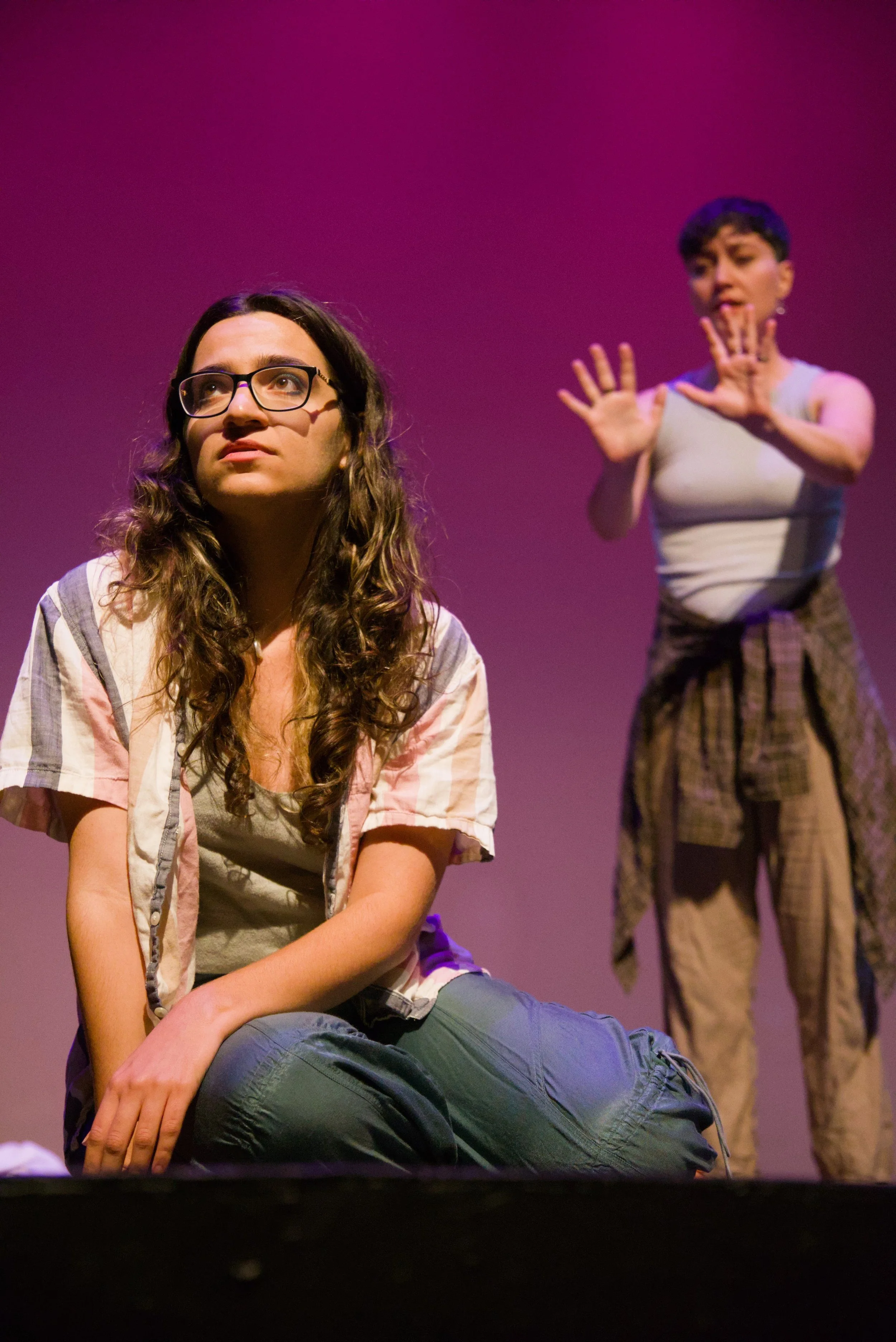
KJ: We really let the form of the piece reveal itself to us. In the beginning, we just knew that we wanted to work with friends across disciplines, and see what might emerge. Many of us work across forms in our regular practice, but have specialties—Juolin [Lee] is primarily a contemporary dancer, Cecilia [Vadalà] is most often a set designer, Jill works full time in comedy/improv world, Sarv [Esmaeili] is a theatre practitioner currently in counselling school, Banafshe [Salehi] works in writing and music, Kelsi is working as a music researcher and dance producer, Beth [Culshaw] is a theatre practitioner also working for a local fishery…
We made the piece by experimenting. We met weekly throughout the summer, and Jill and I would propose experiments—singing and sound, storytelling, movement, art—all centered around water and the ocean. We then threaded these together to make Burn Blue.
TG: The restoration of First Creek and the history of Sema:th Xo:tsa are central to the piece. What did you learn through researching these waterways that changed how you understand the land we live on?
JG: Our conversations around this kept showing up in different ways. For example one day in rehearsal we were exploring directions on how to paint the perfect seascape and this image of the water carving at the rock kept coming up. I remember so vividly that image resonating with the stories of these waterways. We sat in conversation about how the water is inevitable, that the waterways will always return one way or another. And that echo didn’t leave us throughout the process.
KJ: Years ago, I remember reading about the refilling of Sema:th Xo:tsa (Sumas Lake) during the Abbotsford flooding of 2021, and someone saying something along the lines of “the water has been flowing in that area for time immemorial; of course it went back there.” The packing of the lake in the early thirties (to convert it to flat farmland) and the burying of First Creek are both acts of colonization and, as I worked on this piece, also become extended metaphors for the violences of colonization and cultural suppression generally. Colonization says: I can build on top of whatever and whoever was here before, and I can teach everyone that it has only ever been me here.
It was important for us, in making a piece that is centered around the ocean, to center that we are working on Musqueam, Squamish and Tsleil-Waututh territory, and that our ocean is the Salish Sea. We learned so much more about the buried waterways (and current restoration projects), and are better positioned now to, firstly, elect park board commissioners this October and, secondly, show up in solidarity with Indigenous water defenders, who have been fighting for the waterways for many, many generations.
TG: There’s a tension throughout the play between personal relationships with water and the larger issues. How did you approach balancing the intimate with the political?
JG: It’s interesting because many people came to see the show and said it was very political but when I think about the piece, it’s just us sharing our connection to the water. It’s a series of facts and stories.
KJ: I would say that the intimate is political. Our daily lives are deeply impacted by the decisions of political players, globally and municipally. Water has been (and is) so deeply politicized—we are performing this show on stolen land, on top of waterways that have been buried to support settler infrastructure. Our cast is majority-immigrant, who have crossed waterways to be here, who have relationships to water that span continents. We didn’t seek to create a political show, but rather a show that felt true to us, and to our relationships to water—and that, perhaps inevitably, was political.
TG: What do you hope audiences sit with after the performance?
First and foremost, we hope they vote! Municipal elections are October 17th across B.C., and the newly announced provincial election is October 21st.
In the show, there are a couple instructions, which we sing:
“Take your feet down to the shore, plant your toes on the ocean shore, take a breath and then take one more.”
“Don’t look elsewhere, take that breath and look around, don’t look elsewhere, find the sea and find the ground, you’re not elsewhere, you can’t make it not pertain to you, don’t be elsewhere while we burn blue.”
We hope that people spend time with the water and with the land they are on. That they share their stories, and make art, and vote, and engage in civic action in all its many forms. That they breathe deep.
Tasheal Gill is a Vancouver-based film producer whose work centres on community-driven storytelling and underrepresented voices. She is a graduate of the University of British Columbia’s film production program with a minor in creative writing. Her focus, whether in film production or writing, is exploring urban isolation within Vancouver and tackling themes of loneliness and community in modern cities. Follow @tashealll on Instagram for more.