The Little Match Girl strikes a chord of compassion
/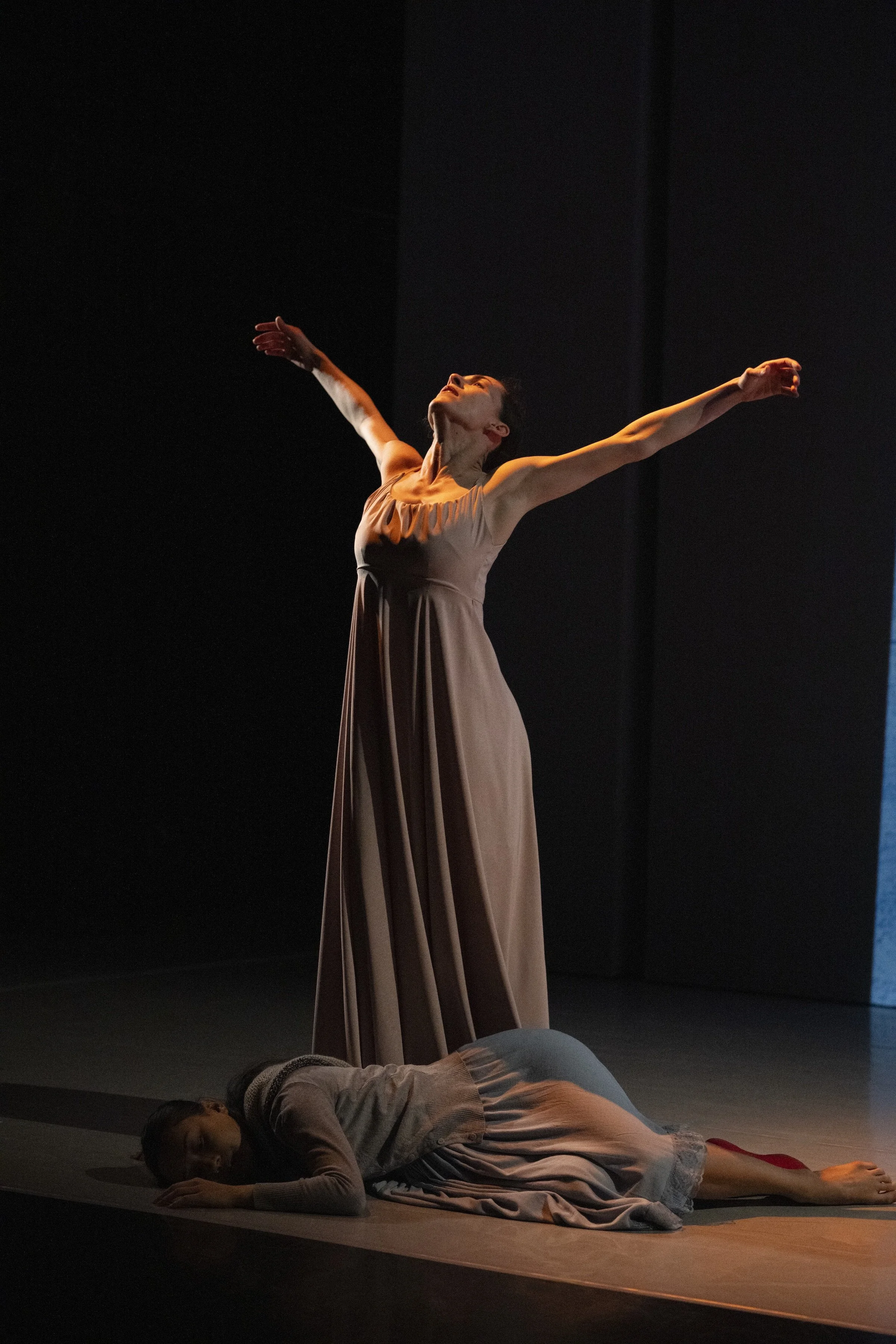
Image courtesy of David Cooper.
It’s a harrowing story to begin with—one that belongs with Grimm’s fairy tales. Hans Christian Anderson’s The Little Match Girl (1845) maps the plight of a poor young girl who struggles to sell matches on a snowy New Years Eve, eventually seeks comfort in lighting the matches herself, then sees visions in her imagination before freezing to death. The story finds its latest adaptation in a new co-production by Belle Spirale dance company and Vancouver Chamber Choir, presented at the Vancouver Playhouse November 13–14, 2026. In partnership with Covenant House Vancouver, an organization working with at-risk youth, it provides a subtle call to action for a topic that hits heavy in our city.
Before the house lights dim, pure and brilliant voices infiltrate the audience chamber with David Lang’s come daughter, the first movement in his Pulitzer-prize winning 2007 composition. Choir members process into the room as dancers dive among them—ruffians chasing after our little match girl (Emma Galvin) who wears a robin’s-egg blue dress. Eventually she ends up onstage, missing one little red shoe, dwarfed by large monolith-like set pieces that provide surface for ever-shifting projections. In a first duet with her grandmother (guest Catalonian artist Alba Nadal), presumably a memory, Galvin holds the stage with a quiet grace that grounds the work from beginning to end.
It is my first time witnessing choreography by the internationally acclaimed Kevin O’Day, who was commissioned by Belle Spirale for this North American premiere (he made a first, smaller version in Germany in 2016). His style seems to pull at the edges of movement—dancers stretch to the very end in sweeping turns, group lifts, and arabesque envelopes that are gratifying to watch. Set to Lang’s haunting score (made even more chilling by the choir’s lit faces hovering above a dark orchestra pit), the work feels luxurious, benefiting from the skin-tingling effect of entwined live music and dance.
After losing her second shoe, the little match girl frantically searches for an opening in the wall. When none is found, she decides to strike her first match. The set begins to shine here—one panel transforms into a huge towering flame and initiates the work’s simple yet effective narrative structure: light a match, then dance out the illusion that comes with it. In the fairy tale, the girl sees loving couples, a smoldering stove, a bedecked Christmas tree, a sumptuous goose, and finally her late grandmother who takes her to heaven. In the performance, these visions are inhabited by character sketches that create a diversion within the piece.
Galvin’s duet with the stove (Lazaro Silva) is a highlight, with sensuous steps and lifts that match the intensity of projected flames. Her dance with the tree (Justin Rapaport, in bright green with a bobble hat that feels oddly out of place) pairs quick shuffle steps with a tentative piano score, in a pas de deux that has a satisfying play of weight and momentum. Lastly, a quirky dance with the brown goose (Will Jessup) takes place against projected backdrop of a beautifully set dinner table. Though it’s obviously meant to be humorous, it’s pitiable how the protagonist continually tries to grasp the delicious goose and he slips away.
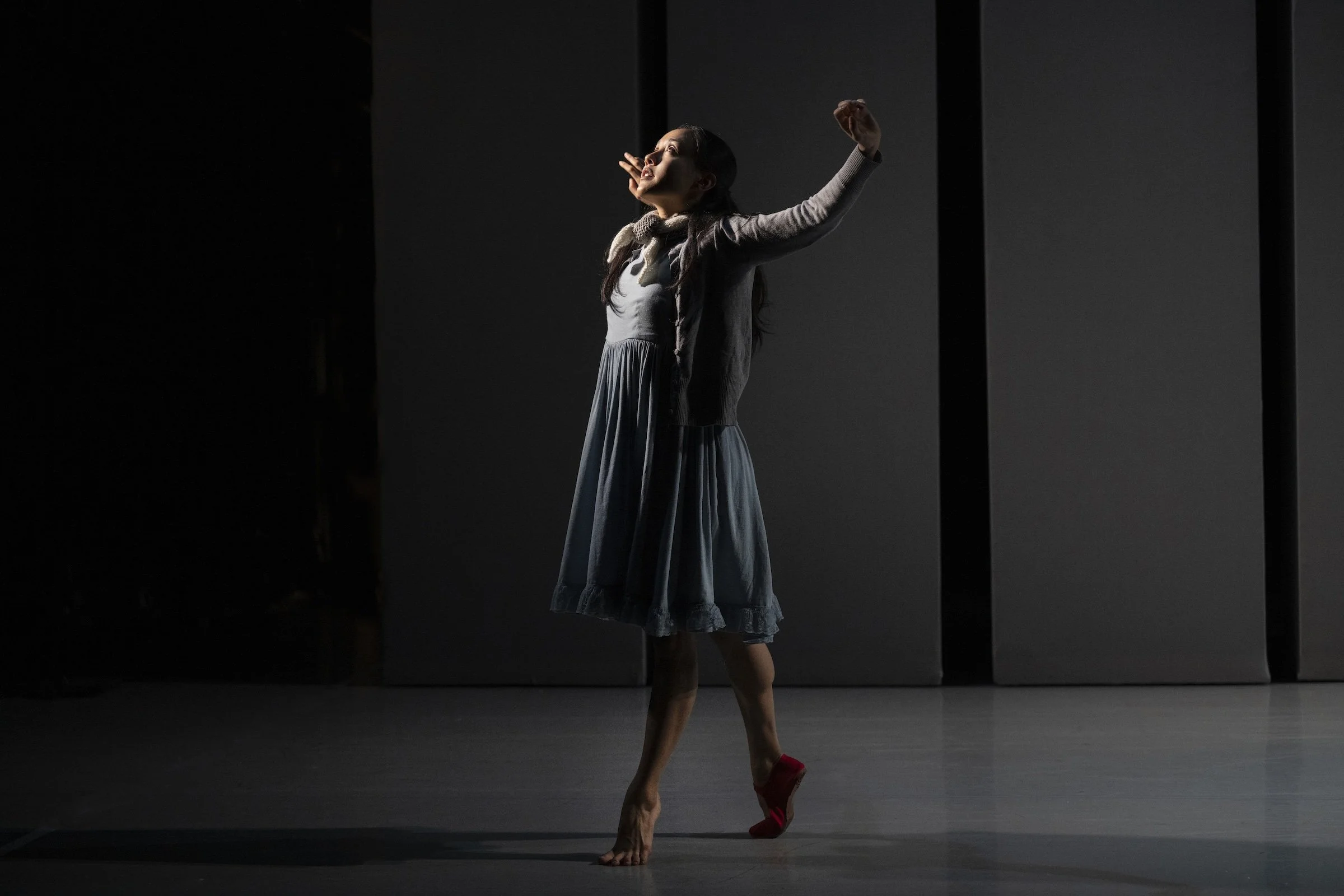
image courtesy of david cooper.
Though these duets are necessary to the story, they don’t quite achieve the impact of other sections. Later, when seven dancers hoist Galvin like a rag doll above their heads, her back arched to the sky as the choir sings, “Lord, have mercy,” it’s impossible not to get goosebumps. O’Day makes stunning use of canons in the group sections, with brief flashes of unison that give our eyes a rest. In between all of it, Galvin keeps returning to her sad spot, huddled barefoot downstage.
The minimalistic set by Thomas Mika (adapted for this stage by Sylvain Senez, with lighting design by Victoria Hunter Bell and projection design by Senez) is unobtrusive, shifting so subtly that I barely notice it to create new architecture for the dancing. At times, the panels represent a wall or an obstacle for our protagonist. In one glorious moment, the grandmother touches a wall and projected flames suddenly engulf the rest of the set pieces, as if catching fire. Near the end, the walls push the match girl to the edge of the stage as a shard of projected light pierces down toward her lonely body—while the sopranos mournfully repeat “stay with me.”
My favourite moments are at the end, when the story is told and we can just immerse ourselves in the dancers’ expression. We watch the grandmother (Nadal) gently pour soft snow on Galvin, silhouetted under low light. After passersby find the girl dead, they pile coats and shoes on her slumped corpse before launching into a moving group piece to dance out their regret. The score comes forward here with silences interspersed with deep percussion and bells that are urgent, as if sounding an alarm. The girl’s final duet with her grandmother is a tear-jerker: as the voices ring out “rest soft,” she is carried gently offstage.
An unexpected and absorbing encore connects the story to our present day. Rapaport is left onstage with a single alto, Maria Golas, who repeats the refrain, “I saw a poor man” (Lang’s poor hymnal, 2023). His feverish solo is a full-body study of desperation. He slides, leaps, and rolls across the stage, extending hands forward as if pleading for food. The sense of precarity is reinforced by the slippery coats and snow strewn across the stage. When the song concludes, Golas snaps their music closed and exits, leaving the man bent double in a cold spotlight.
In a city where many feel the pain of loved ones struggling with poverty and drug use, the choice of this particular story is apt. The evening that I saw the show was a typical dark and rainy November night, with cold water collecting in small lakes on the sides of the streets. My journey home from the Playhouse was marked by encounters with unhoused people downtown; on one corner I saw a few huddled over a makeshift fire for warmth. Saturated with the show, the words of the last song repeated in my mind—“I saw a poor man”—making me realize how callous I’ve become to these scenes that are so pervasive in Vancouver. It urges me to look again, to feel, and to act.
Rachel Silver Maddock (she/her) is an independent dance artist and writer based on the unceded territories of the Musqueam, Squamish and Tsleil-Waututh First Nations. She holds a Masters of Contemporary Arts from SFU’s School for Contemporary Arts. She sees the body as a site of investigation, tool of expression and mysterious archive. Her writing has been published in The Georgia Straight, Dance Central, Comparative Media Arts Journal and SAD Mag.