Tender and truthful Tangles shows us the labour of love
/
I settled into my seat in the Park Theatre on Cambie, surrounded by friends and the hum of attendees at the Vancouver International Film Festival. Earlier I had stood in line making jokes, my throat tight with nerves and anticipation: having some familiarity with the film’s subject matter, I was already regretting agreeing to write this review because I knew I couldn’t write it without making it personal. Then the film began and I started to cry.
Tangles starts with young Sarah (voiced by Fern Grandin) waking up from a bad dream. Her mom, Midge (voiced by Julia Louis-Dreyfus), comes in to soothe her—to save her. Midge takes Sarah seriously, and she takes her job of banishing Sarah’s bad dreams very seriously. It’s late at night or maybe even early morning, but she shows no signs of being tired and is in no hurry to get back to sleep, instead vanquishing the monsters with a flashlight-turned-light saber, play-acting with gusto. The character of Midge is committed to the present. And she clearly finds joy in being a mom. Sarah, too, finds happiness and comfort in her mother, laughing by the end of the scene, the monsters forgotten. Midge leaves the flashlight with Sarah to keep by her side for the rest of the night as a reminder of Midge’s love, a reminder to be strong through the dark.
Jumping a couple of decades and Sarah (voiced by Abbi Jacobson) is a young woman living in San Francisco working as a receptionist for a queer magazine. Sarah is charming, awkward, passionate, and gay, carrying around political posters to paste up wherever she can, and a sketchbook full of naked women. She meets the suave, sexy mechanic Donimo (voiced by Samira Wiley) and in a dynamic and gorgeous animated scene that starts at the club, they immediately fall for each other and straight into bed.
Returning home for a brief family visit, Sarah realizes there’s something wrong with her mother—Midge’s intentional and loving presence we had a glimpse of at the beginning is altered. Midge is different; distracted and irritable. Sarah’s instinct to be anxious about the changes in her mom is eventually proven correct in a heartbreaking sequence that effectively translates how degrading and dehumanizing the medical system often is.
Directed by Leah Nelson in her feature debut, with a screenplay by Nelson, Sarah Leavitt, and Trev Renney, Tangles explores a multitude of terrible complexities: the exhaustion of caretaking and the accompanying resentments that can arise from navigating who in a family does what, and how; the confusion, anger and strange loss of losing a loved one to Alzheimer’s disease; the heaviness of anticipatory grief. The finality of saying goodbye.
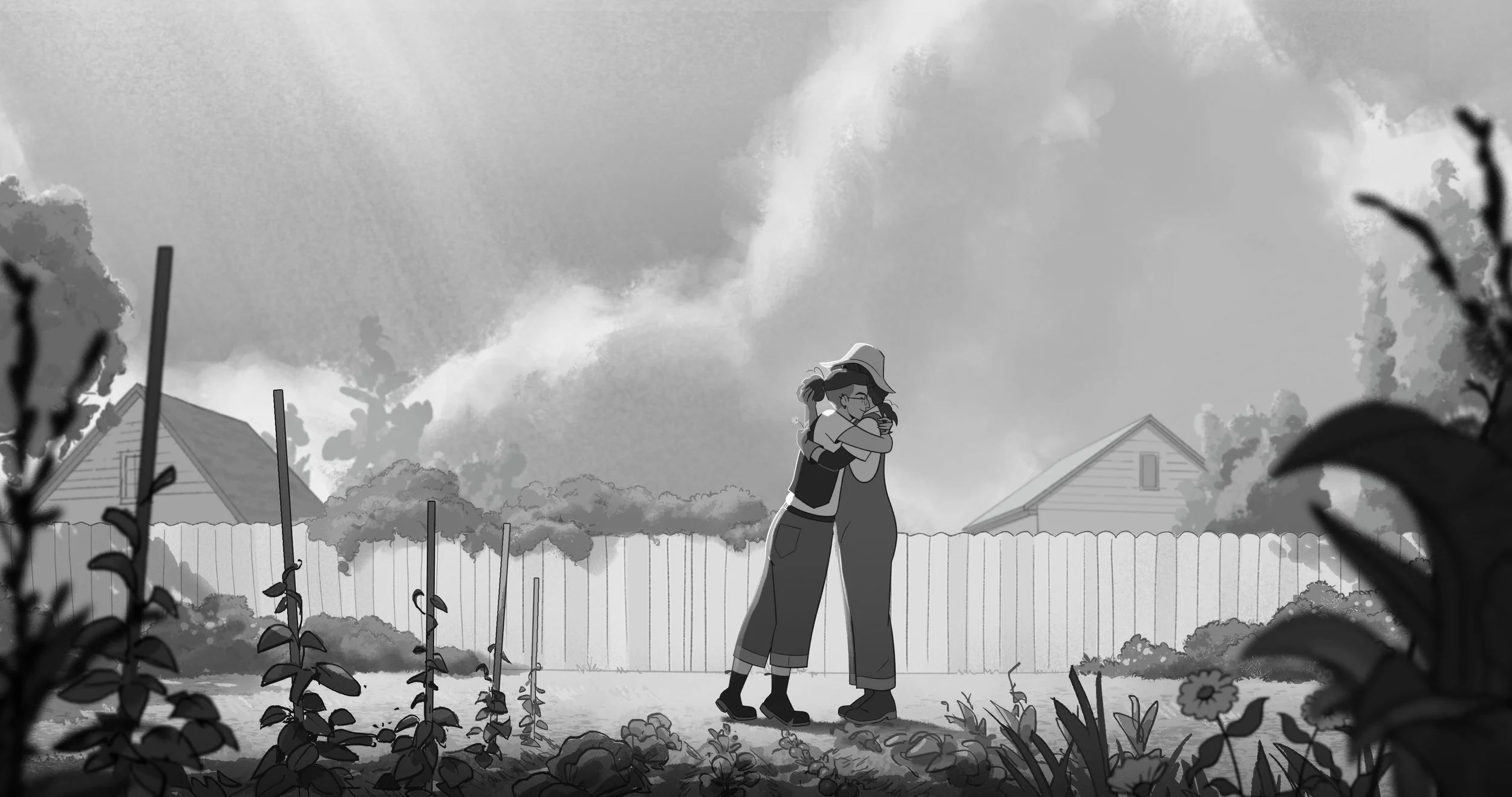
Black-and-white save for a few flashes of magenta and violet seen only during the most emotionally heightened moments, scenes seamlessly morph from grounded settings to Sarah’s imagination and back again. Surreal transformations mirror Sarah’s anxieties and emotions, and we are unmoored with her in a new reality, one where she doesn’t know what’s happening to her previously beloved and vibrant mom. There are brief sequences verging on nightmares, flashes that distill into a few moments the years-long dread of watching Midge slowly lose her memories, identity, and autonomy. In one of them, a doctor administering a test asks Midge to tell the time by drawing a clockface. She is repeatedly unable to do so, her multiple drawings instead show uneven orbs, melting clockhands. It’s agonizing.
And yet, though the pain and suffering depicted made me cry, the film equally and simultaneously made me laugh. Members of Sarah’s family—particularly her father Rob (voiced by Bryan Cranston) and sister Hannah (voiced by Beanie Feldstein)—are all idiosyncratic and fully realized, frustrating and ridiculous and funny. As the story progresses, succinct interludes of Sarah’s flights back-and-forth across the country convey her anxious mindset with dark humour. Each time these in-flight interludes made me gasp with delight through my tears. And the soundtrack, firmly grounded in the nineties and the aughts, is fun.
Woven through the sorrow and laughter is not just the deep familial love but also the heartfelt romance of Sarah and Donimo. Donimo is as supportive and understanding as she is cool, and accompanies Sarah to Mexico to meet her parents shortly after the two women start seeing each other, maneuvering through the uncertainty of Midge’s state alongside Sarah. The family’s easy acceptance of Donimo as Sarah’s girlfriend is a lovely confirmation of their support for their daughter as a gay woman—not typical in a nineties small town—and that support is underscored by a memory of Midge passionately accompanying Sarah to a gay rights protest. Sarah grapples with the limits of her capacity to fully dedicate herself to Donimo as she travels back-and-forth between her family and San Francisco, but their arc is a celebration of radical resistance: of sweet, queer joy.
…How did Tangles manage to tell all of these things in an hour and forty minutes?
The screenplay is adapted from Leavitt’s graphic memoir; it took a decade to adapt the story from book to screen, with the film beautifully hand-drawn in 2D animation and brought to life by Giant Ant, the Vancouver studio co-founded by Nelson. The care poured into this movie is tangible, extending into the credits as personal dedications crowded and filled the frame. Tangles is a labour of love showing us, among many things, what the labour of true love looks like.
My grandpa died from Alzheimer’s disease in his eighties and until the last month of his life my grandma took care of him in the house we all lived in together. This past week marked nine years since my mom passed away at age 54 from breast cancer. From both these experiences there was so much on screen that was familiar: watching a family member fade away over time even though physically they’re still in the room; of watching my sweet, joyful mom struggle with an ugly disease; the sharp, enduring pain of life not going as planned and death arriving instead.
I knew watching the movie would easily stir up grief, and so I hadn’t looked forward to being vulnerable in writing. It’s difficult work for anyone to sort through bad feelings and I’m not always good at it; it’s even more difficult to figure out what of your feelings are relevant to the reader, and should be included on the page. But Tangles succeeded in doing this. Leavitt arranged the mess of her real-life trauma into a complete story, her comic a poignant skeleton with a beating heart; and Nelson and the crew of Tangles transformed that skeleton into something deeply beautiful despite its moving bones not hiding any ugliness. I’m in awe of how genuine, funny, and balanced the screenplay was in its telling.
It was special to take part in the collective experience of watching this in a theatre with others and as the credits started to roll there was a sincere standing ovation, which I hadn’t seen at the movies in a long time. (I don’t attend Cannes!) Outside the theatre after exiting, one friend said that when she expects a movie to be tear-jerker it usually has the opposite effect. She joked that the knowledge acts as a tear-blocker instead. But there we stood with eyes swollen from crying, both of us still tearing up.
April dela Noche Milne is a mixed Filipino-Canadian author-illustrator based in Vancouver on unceded Musqueam, Squamish, and Tsleil-Waututh territories. She is the illustrator for the middle-grade graphic novel The Blue Road: A fable of migration, and contributor to the comic anthology The Witching Hours. Her work has appeared in The Globe & Mail and Chatelaine. A graduate of SFU’s The Writer’s Studio, she’s currently an MFA candidate in Creative Writing at UBC. Nora At Night, April’s debut picture book as author and illustrator, is out now with Kids Can Press.
You can find her at @apricotjoy or aprilmilne.com.