SAD Bookclub: sometimes, forest by Elee Kraljii Gardiner
/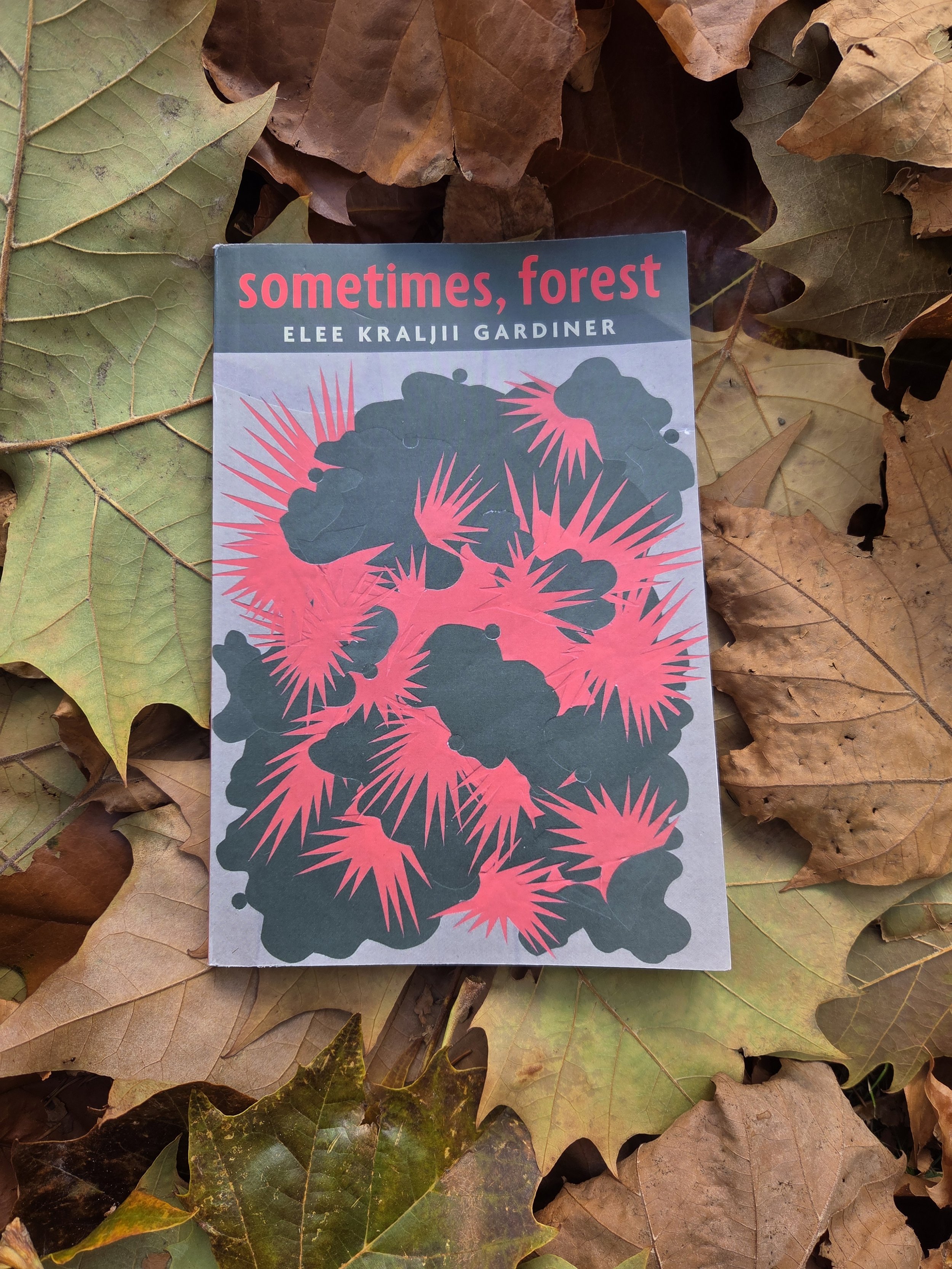
In a 1995 essay entitled “Towards the Greening of Literary Studies,” Canadian eco-critic Sylvia Bowerbank frames “greening” as a project that implicates deep-rooted connections between the personal and the political as she considers how environmental restoration necessitates cultural and psychological transformation. Situating literature as a fertile ground for greening, Bowerbank calls on readers and writers to do the “slow and serious work” that the ecological crisis demands. sometimes, forest, a 2026 collection of 87 poems by Vancouver Poet Laureate Elee Kraljii Gardiner, both fosters and takes part in this urgent, loving labour.
The collection begins with a dedication to “those who are greening” and “anyone who has ever buried something and dug it up.” Gardiner introduces the collection with a preamble, in which she presents sometimes, forest as “an in-situ response to the pandemic and the deadliest weather event recorded in Canada”—the 2021 British Columbia heat dome. She expounds the environmental tragedies fomented by this week of high temperatures: “wildfires, glacial melt, river flooding, landslides […] reduced crop yields,” and mass marine species death.
Despite the monumental scale of the climate catastrophe, the poems in sometimes, forest bring us not to the epicentres of environmental collapse, but into the urban forests surrounding Vancouver. The speaker of Gardiner’s poems “read[s] the woods” with a deep attentiveness to time and textuality as she travels down familiar paths, planting poems for humans and nonhumans alike to encounter in their movements along the trails.
Through repetition and return, and with a focus on pivots, curls, gyres, and circadian clocks, the collection evokes a sense of cyclicality that holds the weight of accumulated environmental histories. Through her feral free-verse fragments, Gardiner constellates an image of the natural world that feels thick with the past. Time is never empty in these ecosystems. In the poem “hunting,” for instance, the speaker’s “voice collides in memory sent from tomorrow.” As Gardiner’s poems unfold in a palimpsestic present that is filled with the non-now, they intimate a connection between the part and the whole that invites us to observe parallel relationships between the local and the global, as well as the body and its environment.
In “first, taste,” the speaker senses distant wildfires on her tongue as she breathes in the urban forest air:
somewhere a burning
house in distress, a field gone in ash, trunks turned
to vapour, flames far
but locally, our air sullen with history
Through this short flurry of incendiary images, the poem models an ecosystemic ethic as it connects the immediate local environment to the larger system of which it is a part.
The poems in sometimes, forest bring the body into nature in sensuous free-verse, creating space for slippage between self and the environment, as well as the internal and external. Across the collection’s pages, the speaker reminds us: “what is kind to the body/is kinder to the woods.” In “direct sowing,” the speaker explicitly explores the connections that emerge in these spaces of slippage:
an article about raised beds got me thinking
about new lands inside me
places untheorized, to be devised
to test if what is within
is what is without
As the poem contemplates a connection between land within and land without, it performs an act of greening, offering a language for theorizing a relationship between the personal and the political at the site of ecology.
In the final pages, Gardiner offers a map to aid readers in navigating the thicket of her rich verses through providing a glossary and a short prose coda. In the coda (titled “boscage,” a term for dense forest grown), Gardiner explains, “[i]n the deeply subjective experience of noticing my body, behaviour, and ‘circular’ thoughts in the woods, I feel the truth of the adage the personal is political.” She continues, “[s]ometimes, to focus on the small detail is to examine qualities inherent in the larger structure.”
sometimes, forest uses mesmerizing minimalist verse to focus on so many small details that contain within them glimmers of larger experiences, structures, and ecosystems. Awakened to both the pleasure and the heartbreak that this slow and serious work offers us, this collection invites us to dig in and take up the task of greening.
Avery Qurashi (she/her) is based in so-called Vancouver. Her book reviews have appeared in Room and EVENT. Avery holds an MA in English from UBC and enjoys reading, choral singing and bike rides to the beach.