SAD Again: Same Jeans, 24 Years Apart
/As people, we have a tendency to attach value to material things. An old watch. A well-worn t-shirt. A pendant, chain long-lost, purchased in the one trip you could never forget. Everyone has their own reasons, though sometimes we fail to recognize the value we assign to things until they are long lost. But for Kiara Okonkwo, her object of value has always been clear: denim, multiple pairs, worn for years by her mother throughout her 20’s before being neatly packed away until they could meet their next owner. Written for SAD’s 37th Issue Time, Okonkwo’s anecdotal “Same Jeans, 24 Years Apart” beautifully encapsulates the issue’s theme. There is a sense of nostalgia that permeates the piece, painting a picture of her mother’s life in meticulous brushstrokes while simultaneously looking ahead to her own life, and the old denim that comes with it.
Though Okonkwo describes her writing style here as ‘bare’, I found the frankness of her writing refreshing, capturing snippets of her life that are essential to her story. With a background in journalism, community organizing and creative writing, Okonkwo has often centered on critical race studies and questions of identity in her studies. Delving into them here through her own mixed background, she describes her experience being raised in a white household, recalling her grandmother’s deep love and the struggles the two generations of women before her underwent before she came to be. A story that holds a lot in just a few words, this is one you won’t want to miss.
Same Jeans, 24 Years Apart
Coming of Age with My Mom
Words by Kiara Okonkwo
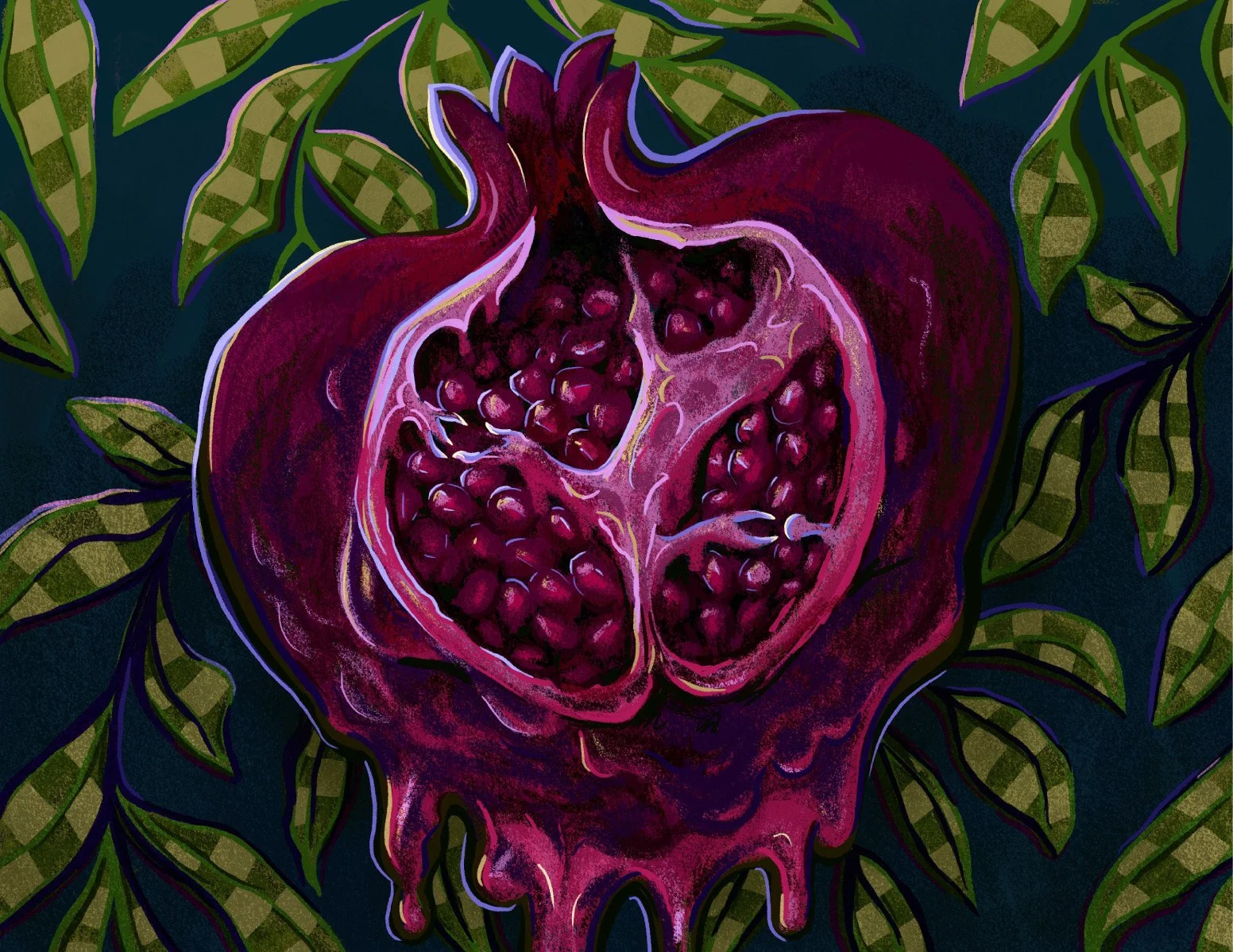
Art by Aleeza Yusuf
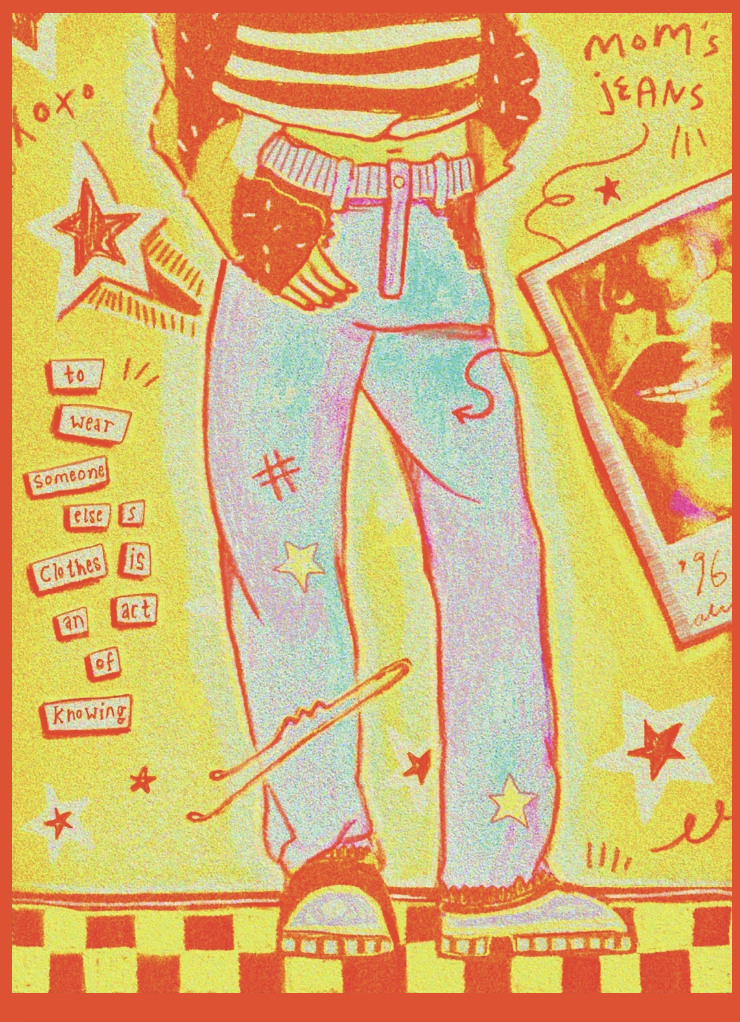
illustration by Aleeza Yusuf for sad issue 37: Time
That photo of my mom, fresh faced and smiling in the LAX airport, a few months pregnant with me. She was on her way to see my father.
Floated. Around our one bedroom basement suite as she taught me to put on my shoes. Turned up. In unlikely places as we changed shelter. The current location is uncertain, but I trust in its timing. That version appears to us only when needed. And when she shows, my mom grips at it like a recurring dream, “Ah! There she is!” As if it isn’t her, but an old friend remembered fondly.
The digital archives of her early 20s, or the years before me, are kept haphazardly. Forgotten only to be remembered. Marked by curling irons, her big, long hair, a staple plaid button up, that signature MAC lipstick in deep red, silver hoops, and Levi’s blue jeans. My mind files those photos away for safekeeping. Pulled up in moments of inspiration; she is the decider in whether I should grow out my hair, to see what I should wear on a first date. My mom before me is something elusive—a girl I can never know, yet yearn to.
And when I ask what she was like in her 20s, she defines it in a word, “raggedy!”
“Living day by day, going to a nail school without any long term plans. I had no direction, not a lot of support…I felt like I wasn’t doing anything constructive with my life, just partying.” That’s the girl who found out she was pregnant with me. I have to wonder if I would have as much grace as her, in the moment she describes to me:
“I had a drink and got sick. A green apple, I think. I didn’t puke, I just felt funny. The next day I was working a shift at Levi’s, and I felt really ill. On my lunch break I went to the clinic in the mall and got a pregnancy test. They came back and said it was positive, so I walked outside and threw out my cigarettes…I was 24.”
A raggedy state of my own, 23 and tearful, spent by the consecutive drunken nights trekking home from work in Yaletown, pit stopping that bar on Granville, ending up in places unknown as the sun peeked through pulled blinds. I had called my mom from under a tree in the park, “I need to come home. I don’t know what I’m doing.” She arrived the next week to help me pack up my apartment. Stood next to me, coaching, as I gave notice to my landlord. Held my hand as I enrolled back into university.
There are parallels in our early 20s that are stark and unspoken. She was never judgemental, always encouraging. Like mother, like daughter, until daughter changes course.
“You saved my life,” she shrugged. “I was going down a bad road, not making good life choices, hanging out with like minded people, who were equally not making good life choices. When I got pregnant, everything stopped, and I left my home in Winnipeg, my friends, and moved to B.C.”
The first grandchild. A mark of social progress in my maternal family’s story of immigration, “Noni asked me if you were Black, and when I said you were, she raised both hands in the air and said ‘yes!’”
My Noni, blue eyed and blonde, had an appreciation for my Blackness that was nurtured by the heightened racial climate of the 90s. Mom opted for love. Every Thanksgiving and Christmas, my mom would cut the turkey asking, “white or dark?” Noni would pinch my cheek, “dark.”
She loved being pregnant. “Though I still felt disconnected from my body, I was like ‘this is not really happening.’ I thought, ‘oh, my stomach is getting bigger, that’s weird.’ I didn’t know what to expect.”
A month before her 25th birthday, she gave birth. Her lips pressed together as I ask about our first year. “I had severe PPD. I was in psychosis. I didn’t know what was happening to me, but I was living with Noni at the time, who was with you every moment.”
With my grandmother as a child. Noni sat at the head of the kitchen table, in a leopard print haljina, a cigarette in one hand and a paintbrush in the other. Our days spent on arts and crafts. We’d fall asleep facing each other, ocean noise machine whirring, rubbing our feet together to make warm.
“I used to think I was going to travel, go to university, become a celebrity makeup artist, have a big house, get married, yup. I also wanted to be a psychologist, but I had no guidance on how to get into university, so I felt that was impossible.”
I can’t think of my mother before me without grief rising, tickling my throat and stinging my eyes. The girl in that photo. The beginning of what she hoped was the nuclear family fairytale, would go through something really big, and really scary, on her own.
Underneath the stairs of our townhouse. Four pairs of Levi jeans. I’d try them on every year when the storage box made way for the tree. My mom would laugh as they fell down from around my hips, eagerly taking them back from me. She’d fold them in threes, the waist down to the thigh, the leg up, with a quick tuck, and place them back in their box. For safekeeping.
We vacated the storage months before Christmas, hands delving into the box reaching for those red, orange, and blue tabs. I’m 24 and her excitement is loud, she’s laughing, covering her eyes with her hands, peeking through split fingers. My body was fuller than it was years ago and my legs slid into the jeans with the good kind of pressure.
To wear someone else’s clothes is an act of knowing. Her jeans. The ones she wore before me, bought only for her employee discount. She stops to take my picture.
Kirsten Danae: I really appreciate how your writing takes its readers through a journey in short, snappy sentences and images that place them in the time about which the piece was written. How would you describe your style of writing and how has it evolved over time?
Kiara Okonkwo: And I appreciate this description of the piece! I would describe my writing style, at least here, as bare. This piece was a frank exploration of my relationship to my mother, to time, and of our relations more broadly. I had a lot of questions during this time and wanted to reflect that in a way that was honest and easily digestible. Now, I find my writing can be more verbose. I think I often oscillate between too much or too little.
KD: In this piece you discuss things like pregnancy and motherhood without shying away from their difficulties. Why was this approach important to you?
KO: I wanted to stick closely to how my mom spoke about this trying time in her life. I think the difficulties expressed in the piece may be coloured by my own fears about pregnancy and motherhood, but I also wanted to offer an alternative viewpoint that was not the sometimes rosy depiction of becoming a mother. I guess in that way I was also satisfying my own curiosities of how I came to be.
KD: We now know there is a lot more to denim than meets the eye. Apart from jeans, what treasured items have you collected over the years?
KO: I have a painted porcelain egg that used to sit on my mothers dressing table. I keep my vitamins in it.
KD: Finally, I’d love to hear about your creative journey and where you are now. What kind of work have you done since writing this piece or, since it is pretty recent, leading up to its publication?
KO: Since writing this piece, I've tried my hand at poetry. Probably needed --- exploring poetic devices has improved my creative writing overall. I had a poem featured in the 3rd issue of SAPP Zine. But most of my writing these days is academic.
Kiara Okonkwo has a background in journalism and creative writing, often interested in critical race theory and issues of identity in media. Currently doing a Masters in Communication Research, she has published writing in SAD in the past, with her poetic work being featured in SAPP Zine.