An Interview with the comedy trio behind Seasoned
/Seasoned is a local improv show on the first Friday of every month from Ese Atawo, Ronald Dario and Kevin Vidal. These three sharp comedic voices come together again for the Just For Laughs Vancouver festival. Catch them on Friday, February 20, 2026 at Little Mountain Gallery.
Ahead of the show, I sat down with the cast to talk about comedy, meteorology, cats, pottery and whatever else drifted into the forecast.
“Ronald, Ese and Kevin are beloved improvisors and friends who just want to do improv together. Make people laugh, say some dumb shit and call it a night!”
Angel Chen: How did you each get into comedy and how did you get into comedy with each other?
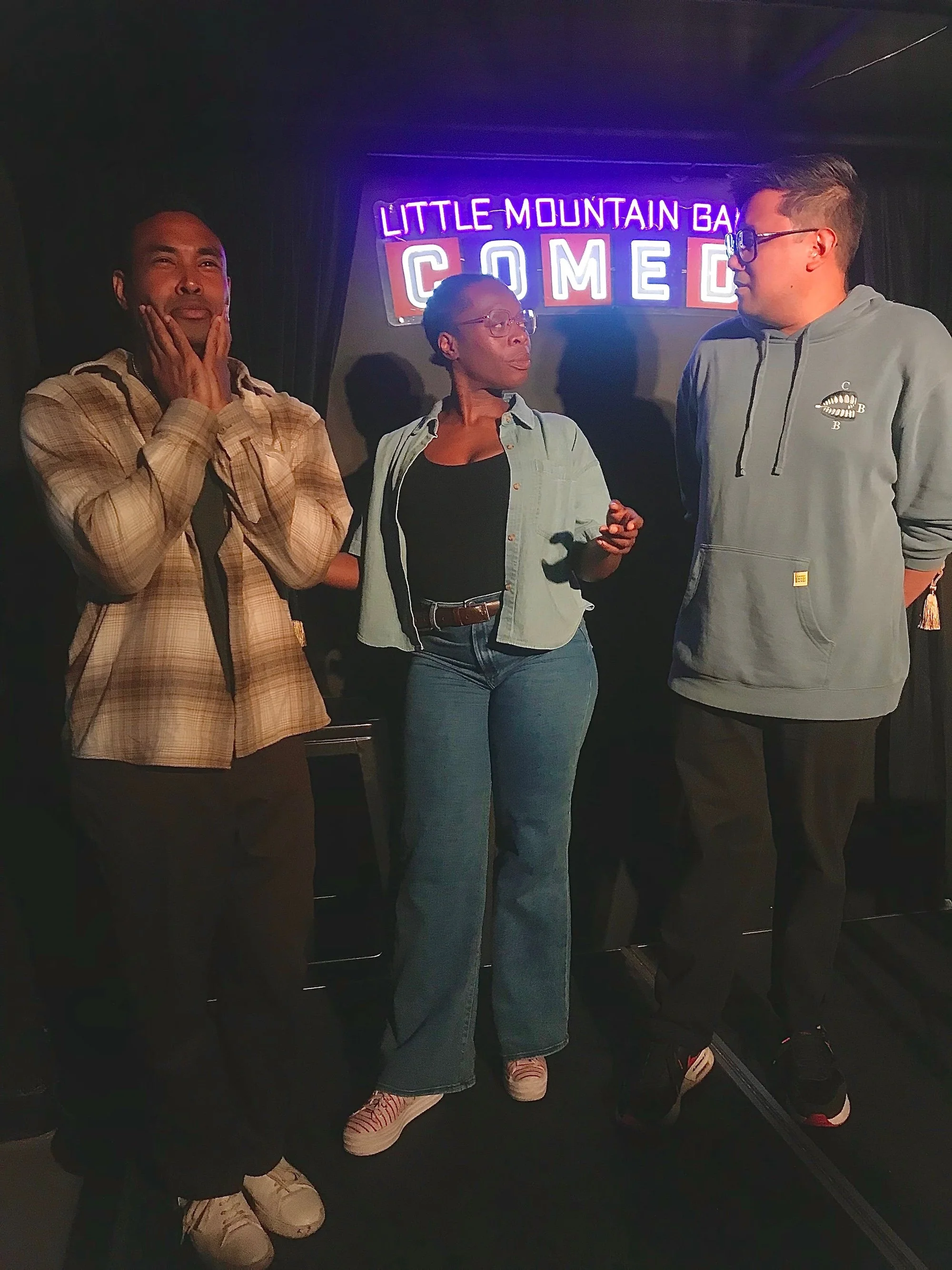
ese atawo, ronald dario, and kevin vidal of comedy trio “seasoned”, in just for laughs vancouver festival. image courtesy of performers.
Ese Atawo: Well, Kevin has always been in my ether for the longest time. I started comedy through Second City Toronto. Did the whole conservatory and all that jazz. When I graduated from Second City, I recall seeing Kevin enter the building. And I was really upset because there wasn't a lot of diversity in my stages of improv. But then Kevin, being Kevin, slayed it in Toronto. I moved to Vancouver because I'm an actor. And then I’ve just been doing improv here in Vancouver since I moved because I just love it and it's fun. And then Kevin, thank God, got married and moved here. I seized the opportunity the second I could to work with him.
AC: Amazing. And, Kevin, how did you get into comedy?
Kevin Vidal: I got into comedy in a weird way, but I started out with musical theatre in high school. And then my best friend went off to do engineering at university, and the engineers at U of T had this sketch comedy musical that they would put on every year.
It was the only show that sold out at the U of T Hart House Theatre. And anybody could audition for it, but it was predominantly put on by the engineering program. And, he was like hey, do you wanna come audition for this thing? So I did.
And then I got in, and that was my start into comedy, sketch and writing. From there I went into Second City. And, yeah, that's where improv kinda entered my life. And then moving out here. Meeting Ese, we just missed each other in Toronto. Then the second I saw her on stage, I was like, oh my god, I have to perform with you. It was instant synergy.
AC: That is beautiful. I'm wondering about the engineer to comedy pipeline too now. Do you think that's a thing?
KV: I think it's pretty few and far between, but my friend that went through the program is now a writer in LA. So you know, there's a few out there.
EA: My uncles are engineers; chemical engineers, civil engineer and another type of engineer, and they're amazing painters.
AC: How did you get into comedy, Ronald?
Ronald Dario: I started getting into comedy as an adult by taking classes at Blind Tiger. I was taking improv and sketch classes, and then I started getting other opportunities. At the sketch classes is where I met Ese, and Blind Tiger is where I ended up meeting Kevin.
AC: Where did the name Seasoned come from?
RD: We were pitching names in our text thread, and I think it's Ese who pitched Seasoned. I'm sure there were hundreds…
EA: You pitched Seasoned, Ronald!
RD: Did I? Yeah. Okay.
EA: I wanted to pick something else.
RD: That's a classic improv/ band name thing. It was the least bad one so we decided Seasoned.
KV: And also it's like putting seasoning on improv. And we all have so much experience…
RD: And baggage.
AC: Tell me about the show next week in the Just For Laughs Festival— what kind of “dumb shit” can we look forward to?
EA: A lot of dumb shit! We've been working on a format that we're keeping a top secret—we're adding our little seasoning into it, which is gonna be fun. Lots of chaos and great characters and ridiculous stories.
AC: How does rehearsing for a show like this work if nothing is scripted?
KV: The thing about rehearsing improv is that it almost feels impossible. You can rehearse the form and obviously the more you play together, the better your communication will be on stage. The form that we're playing with is a form that we've all played in before and also that we've played in together before.
I think improv relies so heavily on trust, you know? Going into the show, I trust the two of them. I try to trust myself.
EA: That's the hard part, trusting yourself.
KV: Yeah. Right? And then also being able to bring the audience along too. We discuss things. We chat about things. And even what we want out of improv as well.
AC: What do you want out of improv?
RD: Oh, jeez. That's a really big question.
KV: Now this is the baggage.
RD: I think for us, it's about having fun with each other, pushing each other a little bit, and just always coming from a place of love and support whenever we're doing it.
EA: And also having fun with the audience. We love playing with each other and we love making each other laugh. But hearing the laughter of the audience and having them inside the joke and having them feel. Even though they're not on stage with us, they're performing with us in a way. That's so much fun.
RD: We like to connect with the audience and chat with them a little bit longer than I think most improv shows in the city do. We really want to have the energy where you feel this is all of us on stage right now, including you in the audience. We talk to different audience members for slightly longer periods of time, get to know something about them, and really start to weave that stuff into the improv that we do later on.
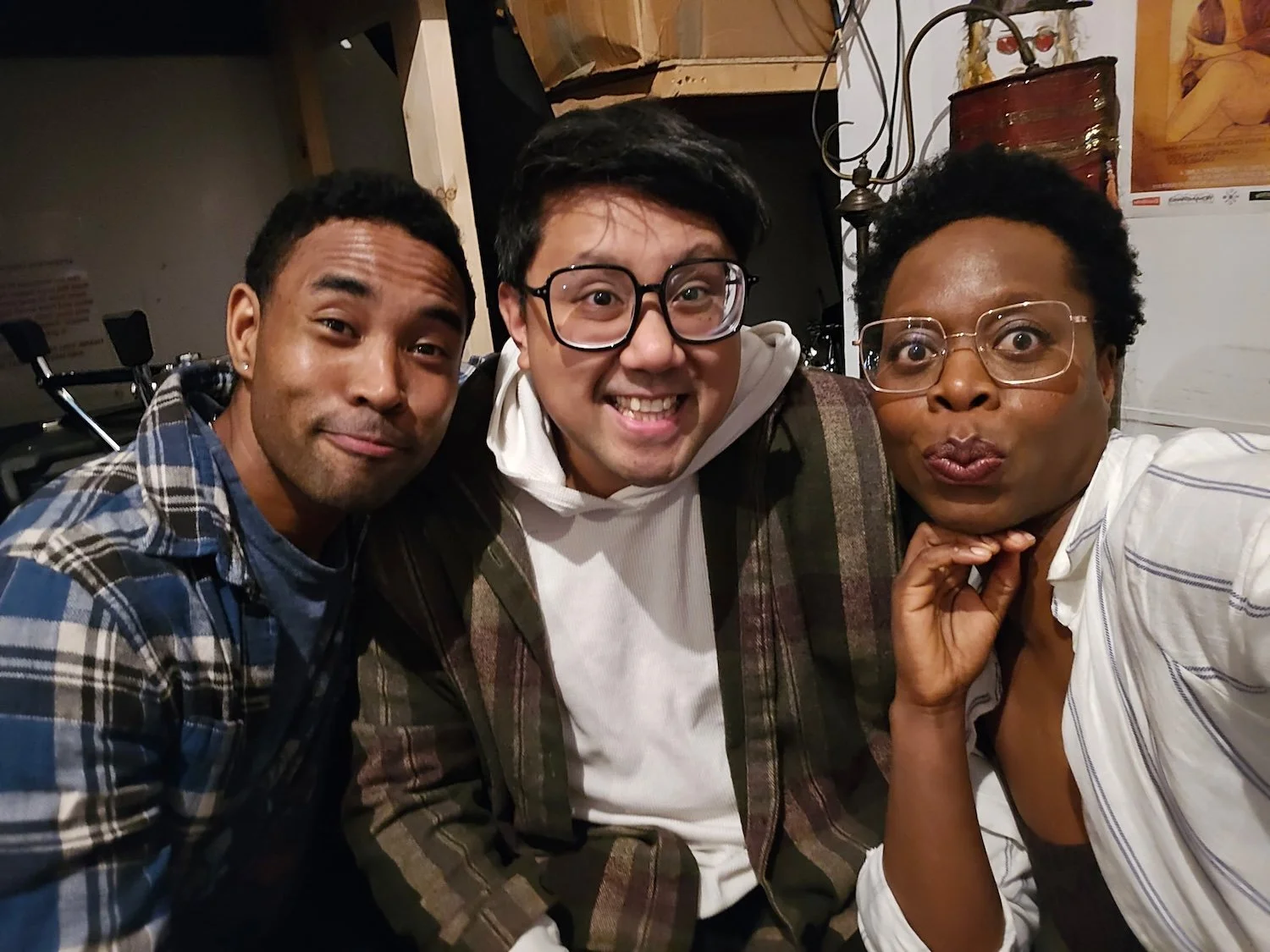
ese atawo, ronald dario, and kevin vidal of comedy trio “seasoned”, in just for laughs vancouver festival. image courtesy of performers.
AC: I really liked what you said about trusting each other. From that trust, you can interact with the audience and each other from a place that is fun and genuine. What do you guys think each other's strengths are? And how do you make sure that you play to each other's strengths when you're on stage?
RD: I think Ese and Kevin are both amazing actors and amazing improvisers. I think that they bring a spontaneity and chaos in a controlled way that a lot of improvisers aren't really able to tap into. They have a very specific and unique way of bringing the most unusual offers into a scene while still saying yes to basically whatever we're creating.
AC: I like the idea of contained chaos.
RD: Yes. The form that we're doing, that’s very top secret, we performed before, and one of our friends said that because we are just chaos, actually having a thing to fit into lets us play within those constraints very effectively.
EA: Ronald is like a beautiful shiny coin. On one side, he is logical. I put my brain on the side and I just trust Ronald and Kevin to know what's happening in the story or who am I in the scene. But with Ronald there is also this sly, unsuspecting, fun terror about him. He's sweet, but he can throw a punch!
KV: I heavily rely on Ronnie for narrative stuff too. He's so good at bringing stuff back full circle when needed.
AC: I'm really interested in the process. This reminds me of this public lecture series in Toronto, hosted by an improv teacher Misha Glouberman where the lecturers are not allowed to speak on things they are professionally an expert in. In the book Chairs Are Where the People Go, co-authored with Sheila Heti, he says most people who take his improv classes are high school teachers. When I read that, I thought maybe I should take an improv class because maybe that will help with my teaching. The parallels between teaching and improvising—the unpredictable nature of everything and the screaming audience. So I've always wanted to try it. But I’m scared. What kind of doubts did you have when you first started doing comedy, and how have those feelings evolved?
KV: I predominantly got into it as an actor to just feel better if I forgot lines or to feel better with the unpredictable on set or on stage. And then coming in from a bit of a sketch background just being a bit of a comedy nerd. I didn’t necessarily get into improv as a craft.
But then the more I started doing it, the more I realized how challenging it was for me. I don't consider myself to be a naturally funny person. There were very, very funny people in my friend groups. I feel like all of the things that I am now has been, inspired by those friends, or by things that I've seen.
But then you just start learning to manage a lot of those feelings because I still feel those feelings. Before the shows, I'm afraid, I’m scared. But you get on stage and trusting that your scene partners and that your friends are there to inspire you and to support you. I would not be doing this if it were not a collaborative form, you know, because it is truly being able to go out there on stage and be like, this is my idea, and everybody is going yeah, I love it!
AC: Kind of like me in the classroom where I go: yes we're all doing this now. Everybody has to go along.
RD: Yes. Yes and the lesson plan.
EA: I second what Kevin said. It’s really just the doubt that I had going in. Like Kevin, I took improv only to heighten my skills as an actor. I was a theatre actor mostly in Toronto. I did a summer workshop in Stratford, and I was performing the monologue in The Winter's Tale. I remember seeing a panel of just old white people staring at me. But I made it funny because I love comedy. I just love to make people laugh. And they hated it. They were just like, ‘you're not funny. You're not a funny person. You're a dramatic actor. You'll always be a dramatic actor.’ And that really hurt me. But then I think after that, I just focused more on comedy to be like, I know that I'm funny. Improv is a space which allows that—everybody has to say yes to your silly ideas, respectfully. Improv allows me to know that my ideas would be supported regardless. And especially with Kevin and Ronald.
AC: Ese, based on my research online, I can see that not only are you an actor and comedian, but you also practice meteorology.
EA: Oh my god.
I do. Thank you very much. Yes. I'm really into being a weather person.
AC: What does the forecast look like for the trio and for you this year?
EA: Bright skies and warm weather ahead for each of us and collectively. And you know if it does rain, we chill and we enjoy the raindrops.
AC: Beautiful. I love that. And for Ronald, I'm dying to know from your perspective, what can cats teach us about comedy and life?
RD: Cats definitely live with an improv nature. They're spontaneous at all times. You can't really read what they're doing. Being like a cat, just going with the flow, whatever you're feeling like in your body, just express it! And there's gonna be some way to justify it. Just live like a cat. Just let go. Do what your impulse tells you to do.
AC: And it doesn't matter what other people think.
RD: It doesn't matter. They're gonna think it's cute, probably, especially if you're a cat.
AC: That's so wise. And for Kevin as you know, centering on the pottery wheel is very important. How do you find your centre when you're on stage?
KV: Honestly in that class I'm like, oh, there are life lessons in this. There's so many life lessons in this. How do I find my centre? You know what? Connecting with the audience and reminding myself that everybody in this room, everybody in this space, we're all going to create something together. Being able to try my best and connect with my scene partners helps me be a bit more centre on stage. Leaning into the unknown and nobody knows what's going to happen. It is scary, but, also, there's something very grounding about it.
AC: Definitely. I recently got into ceramics as well and have been learning the same lessons too. Thank you guys.
This interview was edited for clarity and brevity.
Angel Chen (she/her) is a Chinese-Canadian writer, teacher and visual artist. She has been a featured writer in SAD Mag and hosts Food For Thought, a bi-monthly-ish supper club for Palestine. Angel writes (https://wtsrtn.substack.com/) about what's going on in the garden, the optic quality of the sea and her mom. Angel is interested in the politics of slowness, plants on the sidewalk and friendship. She is not interested in hurrying.