Deo Concedente: Provoked by Grief
/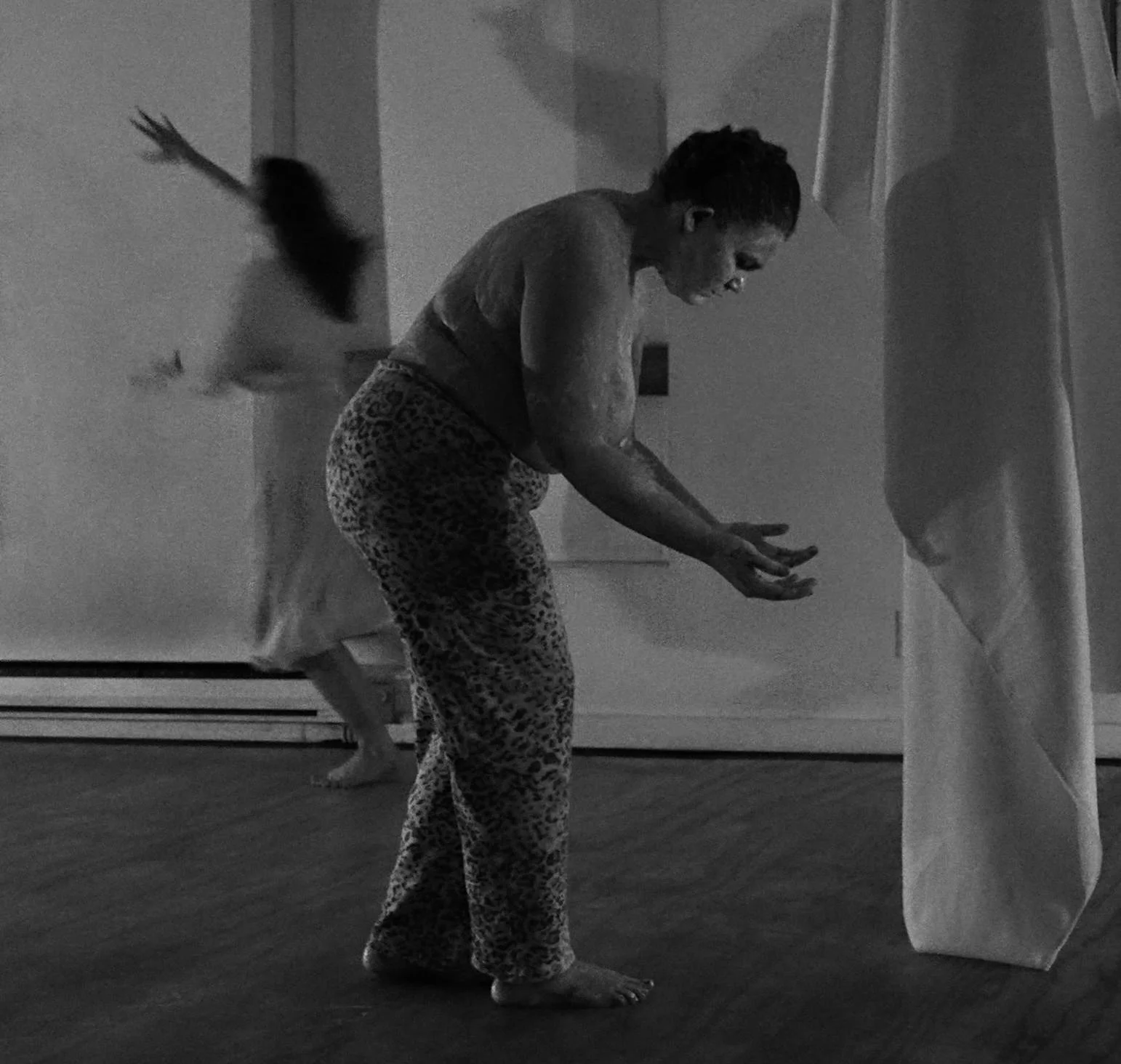
Photography by Thom Stitt. Captured is Kelly McInnes and Eddy van Wyk, image courtesy of eddy van wyk.
The room was enveloped in a heavy silence when we walked in.
Inside the Hobbopshop studio on McLean Drive, the all-white space was stripped back. Every window was covered, save for one, and two small lamps cast a dim glow across the room. The small audience sat along one edge of the room, close enough to see every breath, every step.
Created by Eddy van Wyk as her final performance in Vancouver, Deo Concedente: Provoked by Grief, unfolded less as a narrative and more as an immersive experience. Van Wyk, who has lived in Vancouver since 2009, will return home to Namibia at the end of February. The work, self-produced with support from The Biting School, carried the weight of that departure without explicitly naming it.
Performed as a duet by van Wyk and Kelly McInnes, the piece explored grief through improvised movement, shifting between stillness, turmoil and softness.
The performance began with distance. Van Wyk stood slightly off-centre, her body grounded and largely still. Across the room, McInnes stood at the only uncovered window, looking out at passing vehicles on the street. For several minutes, each seemed absorbed in their own world, existing side by side but separate. The silence was extended, but not empty; there was a sense of anticipation in the room, as though something was building beneath the surface.
Then the movement began.
McInnes’ body carried a restless, almost frantic energy. She paced, put on a coat, attempted to leave, then returned. She was caught in a loop, trying to move forward or move on, but unable to do so. At times, her energy felt like a storm, racing from one end of the room to the other, searching for release.
In contrast, van Wyk’s movements were measured and deliberate. She turned slowly and gradually towards McInnes with a restrained reach that stopped just short of contact. McInnes hesitated, initially responding to van Wyk’s reach with resistance. She yearned for connection but remained apprehensive.
Over time, the space between them shifted. Moments of disconnection gave way to brief instances of mirroring. They would briefly echo each other's movements, then diverge again. When they finally connected, it was cathartic for both the artists and the audience. You could feel the wave of relief move through the room. It was a mutual connection, with each supporting and healing the other.
The piece invoked a ritual-like quality, with certain repeated gestures reinforcing the sense that the work was less about telling a story and more about processing an internal state. The way their bodies repeatedly lowered to the floor, at times collapsing, at other times appearing to seek rest, arms reaching upward before folding inward, one person following the other’s gaze, spoke so much without saying a word.
Van Wyk introduced three musical pieces to the performance. Indian Nights by Steve Gorn, Darpa by Wim Martens and Closed Path by Rabindranath Tagore provided a soundtrack for the intense emotions of the night. The music anchored the weight of emotion, and when it receded, the return to silence felt pronounced, returning attention to the body and the space.
The proximity of the performers to the audience was fundamental to the experience. With no separation between stage and seating, it was impossible for the audience to remove ourselves from the performance. The physical intensity projected into the room, making it noticeable how tension was held both onstage and off. We were reflecting as much as we were watching.
By the final act, the dynamic between the van Wyk and McInnes had changed. Where the piece began in isolation, it moved toward shared presence. The performers connected both physically and emotionally, supporting each other in reciprocated moments of care. In the closing scene, they separated again, but the distance between them was reduced. McInnes lay at the centre of the room, while van Wyk stood by the window, now wearing the coat that McInnes had once found comfort in.
Grief did not need to be fixed or resolved that night; it only needed to be witnessed.
In the context of van Wyk’s departure, the piece also carried an undercurrent of transition. Without stating it directly, the performance held space for loss beyond the personal; it underscored the loss of place, community and continuity.
Provoked by Grief resists a polished or fixed interpretation. In a culture that often preaches stoicism, demanding a performance of scripted grief with a swift resolution, van Wyk reminds us to sit with our feelings, and recognize the experience of grief for and within ourselves.
Nicole Wasuna is a Vancouver-based writer originally from Kenya. She writes about books, film and performance, with a particular interest in how stories engage with race, gender, queerness, class and disability.