SAD Again: Bebop Tattoo Shop
/
photography by joseph gulizia for sad issue 27: nostalgia
Though picking my favourite SAD Issue is comparable to picking my favourite child (if I had one) I can confidently say that the Nostalgia Issue published in 2019 holds a special place in my heart. As someone who often indulges in nostalgic media, I found this particular issue to be a treasure trove for poems, essays and fictional ramblings contemplating those things that transport us back in time. Nostalgia is present everywhere, and Whitney Brennan sums that up perfectly in her profile of “Bebop Ink”. Having previously explored the art of tattoos during her Masters in Art History, she dives deeper into a tattooist’s ability to work meaningful memories onto their clients’ skin, creating a sense of permanence. Which seems to be both the drawback (for the skeptical) and the appeal (for the ink lovers).
When asking Brennan about the connection between writing and tattoos, she initially seemed to suggest that writing feels more malleable because we leave it on the page, while tattoos are inherently permanent. But then again, they have the ability to transform in meaning and even design as people grow. How many people go into a shop to have their ex-lover’s name re-shaped into a thorny rose? Or a roaring lion? How many give it new meaning, seeking out lovers with the same name for all eternity…or not. Elements can be added and removed the same as in writing, and though it is a big commitment, looking back at a happy memory edged upon your skin can be enough to summon that warm and fuzzy nostalgic feeling. Which is exactly what the artists of Bebop Ink strive to do.
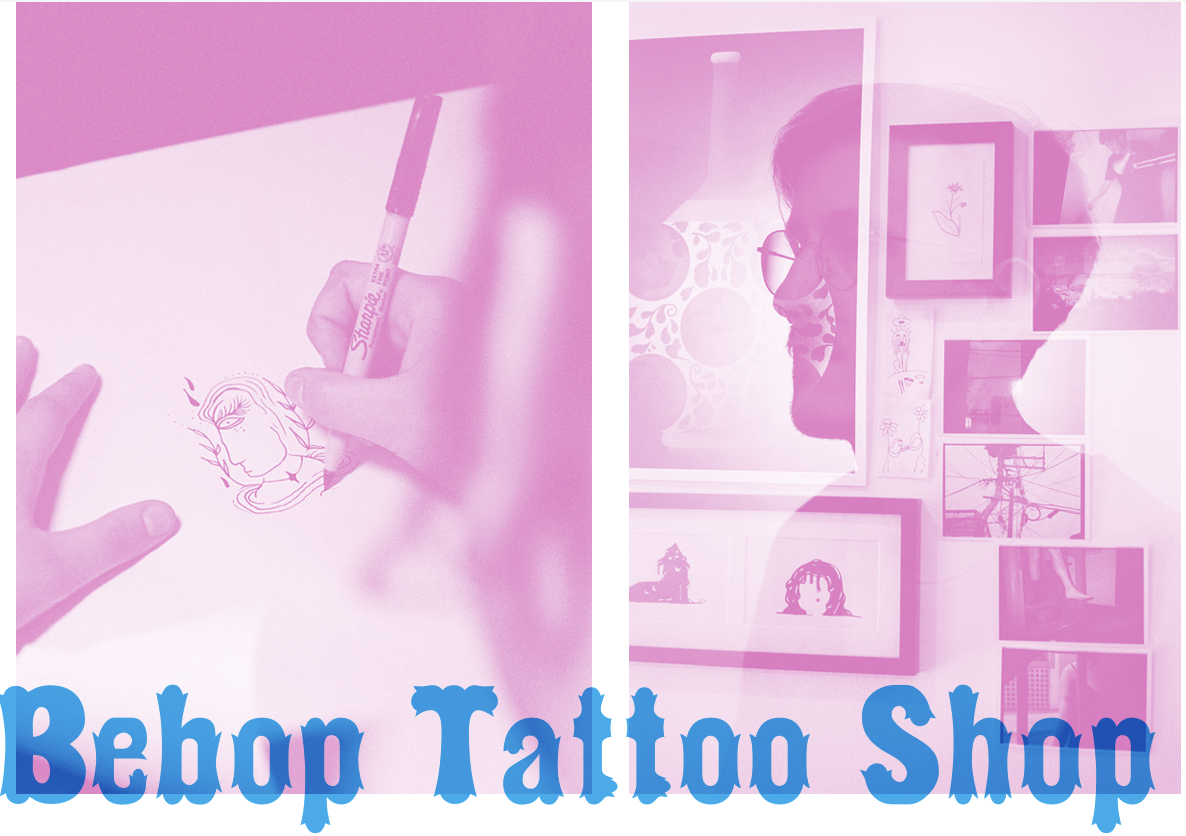
Bebop Tattoo Shop
Interview with Akira Mikoshiba and the artists at Bebop Ink
Words by Whitney Brennan
Photography by Joseph Gulizia
Walking into Bebop Ink, you might get the impression that you’ve stepped into an artist’s studio or creative co-working space instead of Mount Pleasant’s newest tattoo shop.
However, in between the bright yellow- and pink-accented walls are massage tables and clusters of drawings, both staples of tattooing stations the world over. The shop presents a cozy, laidback vibe that’s not usually found in tattoo studios, which more often boast loud music and a harsher, more impersonal appearance. The artists at Bebop Ink aim to make their clients’ experiences memorable and enjoyable, in addition to providing high-quality tattoos. For shop owner Akira Mikoshiba, the goal of the space is to provide a workshop for artists to explore their creativity, while establishing a business that is comfortable and welcoming for clients, to add to the memory-making intentions of receiving a tattoo.
I sat down with Akira and tattoo artists Ariane Lapointe, Layla Chen, and Vanessa Taylor to discuss a peculiar shift in the tattoo world: the rise of the assumedly meaningless flash drawings. Unlike custom tattoos, wherein image or design originates with the client, flash tattoos are existing illustrations that tattoo artists have pre-designed.
Tattoos often have an air of nostalgia, of evoking personal memories of people, places, or particularly, as Mikoshiba noted, pets. “Especially after they’re not here anymore, you’d be reminded of them every time you see [the tattoo], so in that way tattoos spark nostalgia quite a bit.” Tattoos as markers of memory and impactful experiences take on a variety of forms: from travelling, graduation, friendships and family, and the nuances of personal histories that create meaning through specific symbols and motifs.
This was a normal practice for many tattoo artists for decades: careful, emotional commemorations of loved things lost. While custom artwork is always popular because the client can choose the personalized imagery to have tattooed on their skin, meaning can also be embedded in an otherwise “un-meaningful” image, and this is where the flash tattoo drawing comes in. Lapointe noted that while she and the other Bebop artists prefer to do flash work, those seemingly impersonal drawings become filled with meaning when a client chooses them.
“I tattooed this bag of oranges on this person two weeks ago,” Lapointe said, “and I didn’t think anyone would want it, it was just a bag of oranges. And [the client] said their grandma used to carry her oranges in a bag like that, and for them it brought back memories.” Contrary to popular belief, flash drawings can end up having as much, if not more meaning inserted into them, which the artist can never anticipate. “Every time you tattoo someone and they give you the meaning of it, that’s pretty incredible,” Lapointe added.
Fellow artist Layla Chen has had similar experiences with her drawings and portraits. Her trademark character drawing, a featureless female with a short black bob haircut, reminded one client of a woman in his life who had passed away.
While the tattoo itself can be a memorialisation of a lost loved one, the memory of receiving the tattoo can be just as impactful for the client. For tattoo artists, as one can imagine, this feeling is even more nuanced. For artist Vanessa Taylor, each memory of getting tattooed by a fellow tattoo artist and spending time with that artist during the process, “[that experience] holds a lot of nostalgia for me.” This experiential memory of getting tattooed seemed to be a direct motivation for Mikoshiba to create a positive, safe, and accessible space at Bebop Ink. “I think that’s also why safe spaces are so important,” Taylor added, “because it’s something you carry with you for life, and you’re going to have that memory with you, you want to have that good experience...A traumatic time [will stick] with you.”
Lapointe commented on the shift in meaning in tattoos, as well. “I feel that when having tattoos was less accepted, they had to all mean something to be able to justify it.” But now, clients often choose to create a new memory, a future reminder of the time they visited a city or a specific tattoo artist, and the work becomes meaningful through the experience of receiving the tattoo itself. In anticipation of forgetting a specific time or place or in order to create new meaning through an experience like receiving a tattoo, the feeling of memorializing something permanently appears to hold a deeper sense of personal reflection, of solidifying a memory in a way that can’t be held in a photograph or souvenir. Inserting personal connotations into images like flash drawings and then, more radically, imprinting those images onto the skin forms a bond between the wearer and the symbol, a palpable link to their past or a visible reminder of the present that they can carry with them without the fear of loss or forgetting.
Kirsten Danae: Where were you at in your creative journey when you wrote this? What drew you to Akira Mikoshiba’s Bebop Ink?
Whitney Brennan: When I wrote this piece, I had recently completed my Master of Arts in Art History: Critical and Curatorial Studies at UBC, and had written about tattooing in my academic work during my undergrad as well as master's classes. I was connected to SAD Mag through a mutual friend and writer who suggested I reach out to a new shop that had opened in Mount Pleasant. SAD Mag was looking for stories for their "Nostalgia" edition. I was drawn to Bebop's approach to providing a tattooing experience that was memorable and created feelings of safety for clients. Having worked in a more 'traditional' tattoo shop in the past, I loved their dedication to creating a welcoming atmosphere.
KD: As you emphasize in your piece, tattoos offer a unique sense of nostalgia and permanence by being worked directly onto the skin. As a writer, do you think you take a similar approach when crafting a piece?
WB: What I think is interesting about writing, like tattooing, is how our interpretation can shift and grow over time. While writing does capture a moment in time, I have seen my own perspectives develop as I have grown as a writer. The idea of permanence is a funny one; tattoos do last 'forever' but can be altered, erased or modified as people change and grow. What I enjoy about the permanence of tattoos echoes what lives on in writing. Revisiting older written work is like taking a step back in time; you might remember who or where you were when you produced it. I remember being so excited to chat with Akira and the Bebop folks - I booked a tattoo with Vanessa following the interview!
KD: What would your ideal tattoo look like, and is there nostalgia attached to it?
WB: Oof, the ideal tattoo! If ever a thing could exist, I think it would include the memory of its creation and execution, as the artists at Bebop said, that the memory of getting a tattoo is also significant and part of the meaning of the tattoo itself. I have a couple pieces from my best friend who recently started tattooing, so those are up there with the best memories. Shout out to Siwin Lo for letting me be part of her tattooing journey!
KD: Of course, I have to ask, what have you been up to since writing this piece?
WB: Since I wrote this in 2019, I've been on a journey that I didn't think I would be on back then. I went back to school to get my Bachelor of Education and have been a classroom teacher in Richmond for the past three years. I credit my experience in writing to being able to bring creativity, vulnerability and expression to my teaching, and I love to encourage my students to pursue their own writing dreams. I've also had the opportunity to explore my own artistic practice and have exhibited digitally, locally, and elsewhere in the province.
Whitney Brennan graduated from the University of British Columbia with a Master of Arts in Art History: Critical and Curatorial Studies. Whitney is currently a teacher, and has always been intrigued by the art of tattoos (having a few herself). You can find her on Instagram @whitbrennan.