‘No Stress Chess’ and When Chess Becomes an Opening
/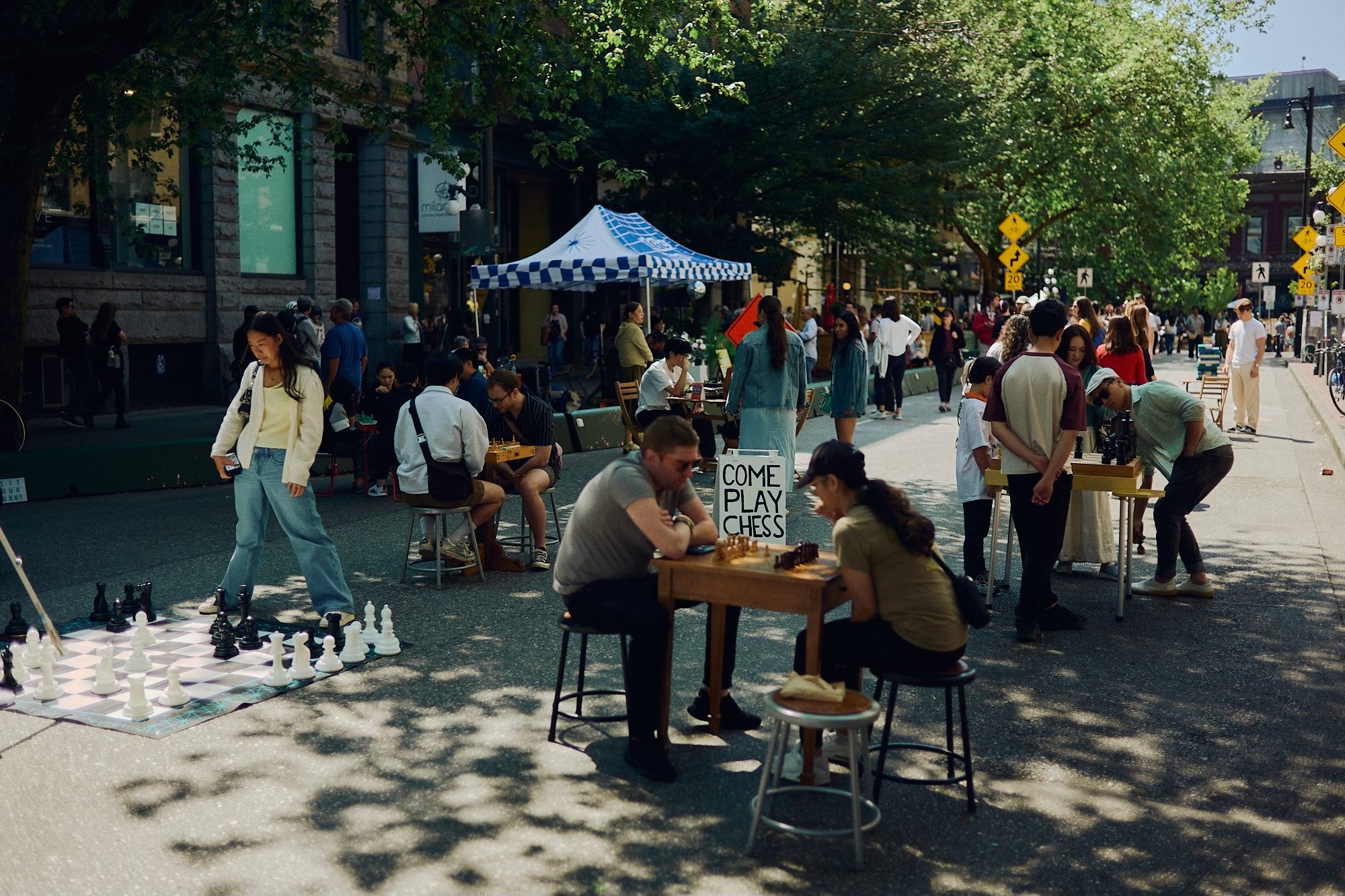
image courtesy of THOMAS MAXEY
Vancouver has a reputation for being a lonely city. It’s beautiful and crowded, yet somehow we’ve decided upon a culture where we owe each other no friendly courtesies. We pass each other on sidewalks, sit beside strangers on buses, share dance floors, cafes, and parks, but rarely do we make room for connection outside of our own bubbles. And in this city where connection can feel difficult to come by, there is something quietly radical about creating a space where you can simply show up and be part of something outside of yourself.
This is what No Stress Chess embodies. It’s a chess club without the membership, the ranking or requirement to even know how to play. Radical by nature, No Stress Chess welcomes people of all genders and backgrounds, positioning itself as apart from the traditional chess spaces with the incorporation of music, dancing and expression of all kinds.
No Stress Chess has hosted at Gastown’s car free series, beloved east van staple of the Lido, high-ceilinged wine bar La Fabrique St. George and so many other special locations around the city. There are chessboards set up in public spaces, often in conjunction with other organizations such as Public Disco. With each event, you won’t know exactly what to expect aside from the guarantee of a quirky chess board and strangers who are eager to face off.
At the centre of this experiment is Thomas Maxey, the founder of No Stress Chess, a DJ and artist whose love of music has become inseparable from his fascination with the ancient game. His gatherings exist somewhere between a chess club, a public living room and a listening party. You might find a collection of Thomas’ unusual and storied chess sets spread across a table while a DJ spins nearby. Someone might be playing their first ever game beside someone who has been playing for years. There are take backs. There is conversation. There is music. There is no pressure to win, and so, no pressure to be anyone other than yourself.
Chess asks you to look closely at another person’s position before you make your move. You have to imagine what they are seeing, consider what they might do next, and accept that your understanding of the board is incomplete. With No Stress Chess, Maxey poses a deceptively simple question: what happens when we give strangers a reason to sit down together and consider each other?
Tasheal Gill: What made you want to create No Stress Chess?
Thomas Maxey: Vancouver needs more honesty. We’re blessed to live in this beautiful city, but the culture can feel colder than we deserve. I understand Vancouver is absurdly expensive, overcomplicated, and draconian, but the truth is we’re stuck living with the consequences of decisions made for us thousands of years ago. Chess gives us a gentle way to collectively untangle that mess and learn how to see both sides and hold two truths at the same time.
I also want more things to be free in this world. If someone comes to one of my pop-ups and plays without having to pay, maybe that helps water the seed inside them to bring their own crazy idea to life.
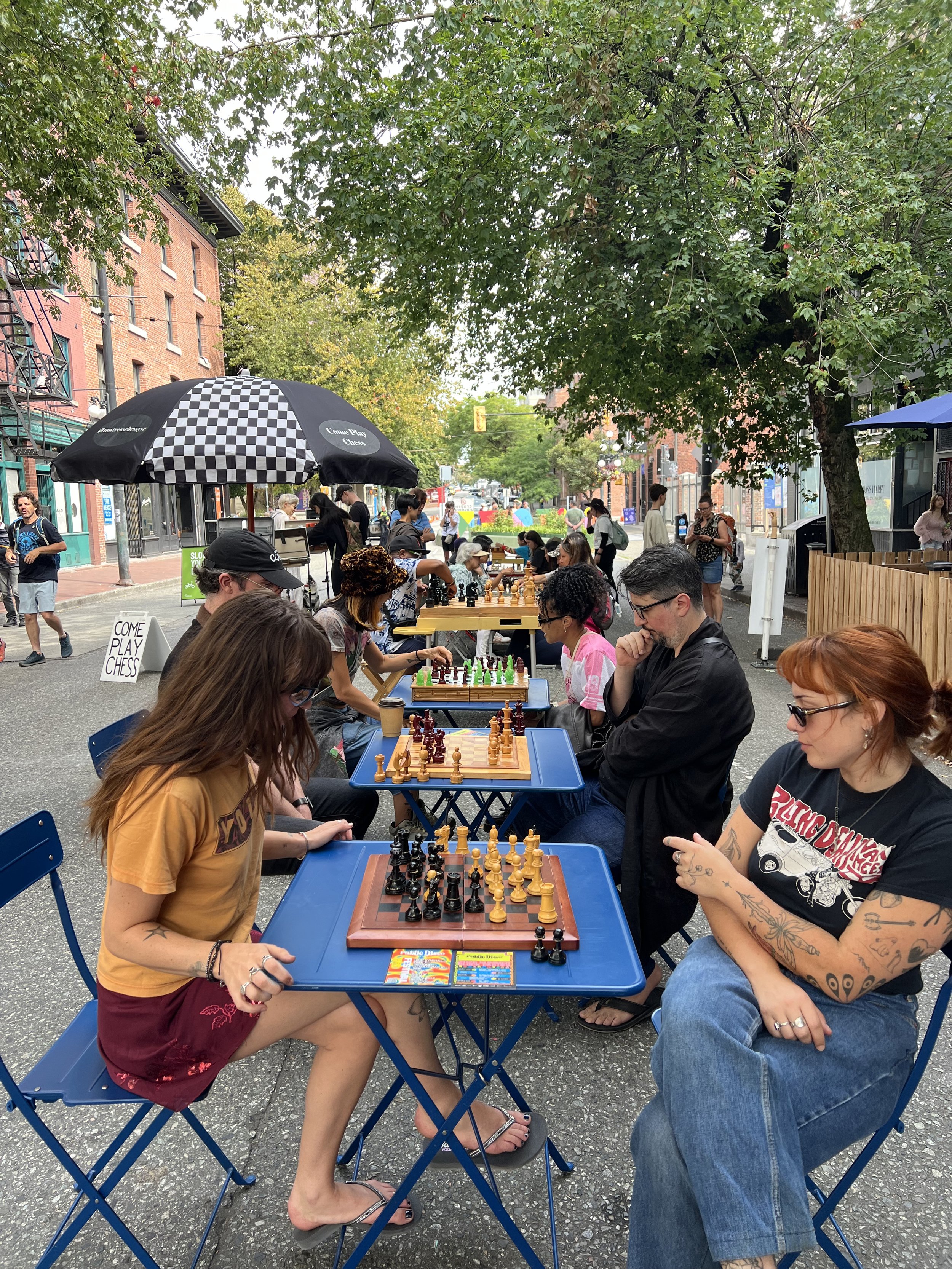
IMAGE COURTESY OF AUTHOR
TG: Why “no stress chess”?
TM: The more we unpack just how abnormal the world is, and what so-called adults normalize, the more stressful it becomes. Playing chess allows us to slow down, zoom out and see the full picture from a bird’s-eye view. The mistakes we make along the way can be seen for what they are and corrected by seeing the board through someone else’s eyes. If you can’t understand how they see things, you lose. But you always have the chance to try love again. Cue “Try Love Again” by The Natural Four. People often tell me they’re stressed playing chess, and that’s the point. Let’s keep stressing over this evolving puzzle of a game so that when it comes to how we approach life, the stress is more manageable. Practicing stress over the board teaches us how to meet life more gracefully.
TG: Why do you think people are hungry for these kinds of low-stakes, in-person interactions right now?
TM: Play is how we remember how to build together. Chess isn’t an escape or a distraction. It’s a tool for weaving people back together. Playing is one of the greatest things we can do to create change. We need to start throwing rocks in the same direction instead of throwing rocks in all directions. Screens are destroying the very essence of human nature, which is to experience and create. Playing brings us back to both.
TG: What’s the most interesting thing you’ve learned about strangers from watching them play chess?
TM: How quickly strangers stop being strangers. You put a chessboard between two people who never would have spoken otherwise, and this cure to small talk allows them to actually see each other. Age, background and all the other things we use to separate ourselves dissolve. There are just two people sitting across from each other trying to figure something out together.
TG: Chess is a game, but it’s also an exercise in ego. What have you learned about your own ego through playing?
TM: That I have a giant ego. One big enough to believe that this game can remind us how important it is to collaborate and build together, so we can all do our part to leave this planet better than we found it. And to understand that presence is the highest form of power.
There are three things you must look for in chess. The most important thing is to put someone in check. The second is to capture their piece. The third is to attack. In life, I feel the most important thing we can have is awareness. The second is compassion. The third is kindness.
So:
Check your awareness.
Capture compassion.
Attack with kindness.
TG: You’ve fused your love for chess and music together. Do you see a connection between the two?
TM: More and more every day. They’re both universal languages, and they’re both future-telling experiences. A chess player looks at the position in front of them to determine the best move for the future. A DJ does the same thing, reading the frequency that’s present, the energy of the environment and the vibration of people’s body language to figure out what song is best for the moment. Musicians do this too, deciding what note or chord should follow the one being played right now. They all require being deeply present while simultaneously imagining the future. Not to mention, the 64 squares of a chessboard can be seen as a 16-bar verse: 64 beats. Chess is the younger sibling to music. Music is hundreds of thousands of years old, while chess is only fifteen hundred years old. Music unites us, and chess is slowly leaving behind its austere reputation to become recognized as social glue.
TG: What do you think Vancouver is missing that No Stress Chess is trying, even in a small way, to create?
Culture where people don’t just observe, they participate. Music creates spaces to celebrate the sacredness of sound through dance, but there’s still a separation between the person experiencing the art and the art itself. Chess turns people into the art. You’re no longer there just to witness something. You become part of something greater.
TG: Anything else you’d like to add?
TM: No Stress Chess is a public living room in Vancouver. We bring treasured chess sets and play alongside low-volume vinyl. All levels are welcome. Take backs encouraged. Drop in solo or with friends. Play, read, draw, or just be! Slowing down is the fastest way to real connection.
Follow @nostresschessyvr and come play.
Tasheal Gill is a Vancouver-based film producer whose work centres on community-driven storytelling and underrepresented voices. She is a graduate of the University of British Columbia’s film production program with a minor in creative writing. Her focus, whether in film production or writing, is exploring urban isolation within Vancouver and tackling themes of loneliness and community in modern cities. Follow @tashealll on Instagram for more.