WATER / COLOUR at Pale Fire
/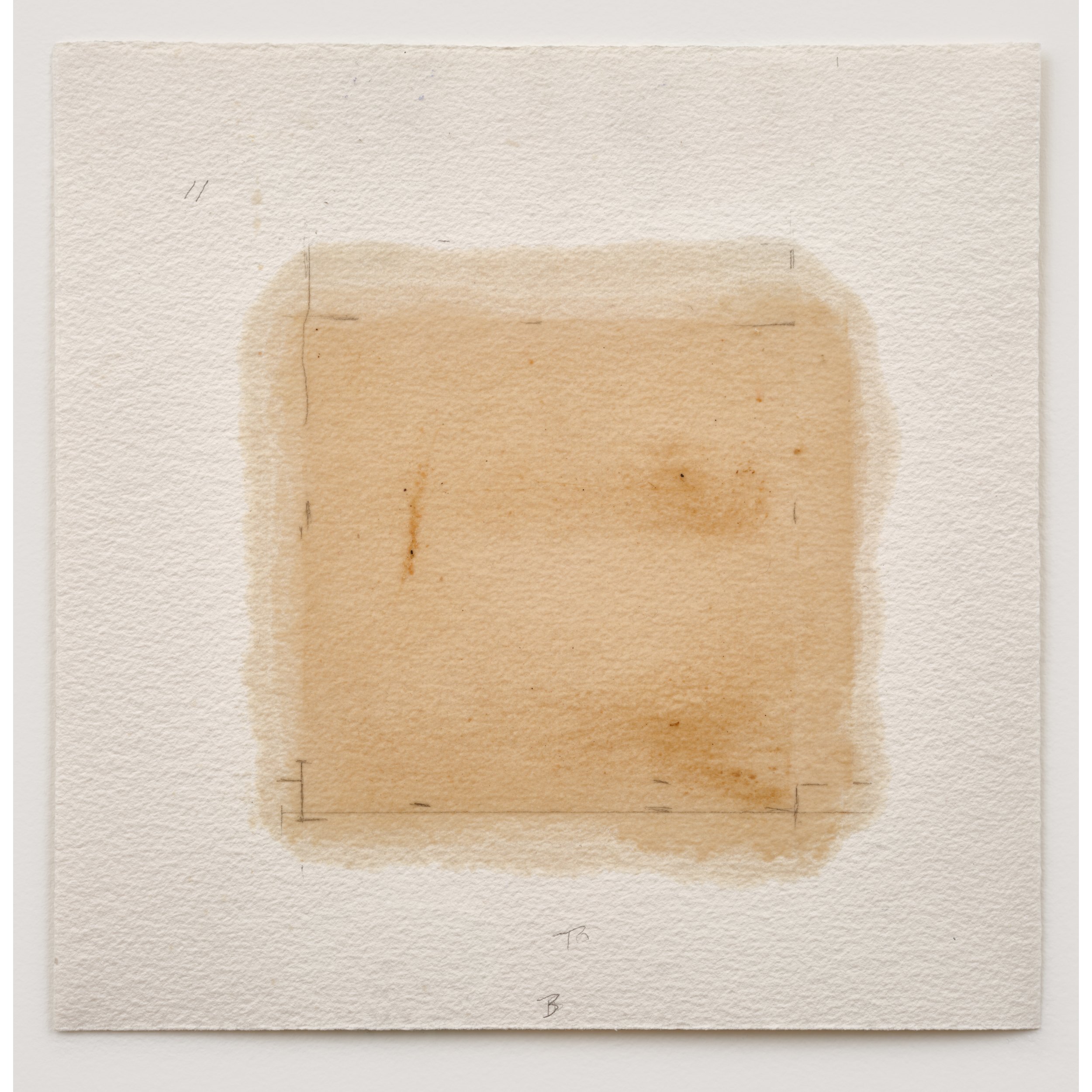
Judith Williams, Bute Wax, 2025. 10 x 10 in. Schnarr's Bute Wax on paper. Collected by August Schnarr c.1920s. Photo credit: Rachel Topham Photography. Courtesy the artist and Pale Fire.
An unseasonably dry January has welcomed those of us in so-called Vancouver into the calendar year. December of 2025, in stark contrast, saw atmospheric rivers rushing through the province—the nearby region of Abbotsford pushed underwater in a grim reiteration of familiar flood patterns. As the pendulum of climate extremes swings ever more wildly, water responds: tells histories, tells stories of our future. We do good to listen closely.
Stepping off of Broadway into Pale Fire gallery in the early darkness of this January night, I am greeted by a relieving, bright spaciousness. A series of subtle works, suspended quietly against a neutral river of colour, touch me as gazing upon pieces of skin would: they are water bodies, small portals into the greater networks of life that they are connected to. Judith Williams' show, WATER / COLOUR, is a collection of water paintings.

Judith Williams, Southgate River (two upright triangles), 2021. 19 x 22 1/4 in. River water after 2021 Elliot Creek landslide [Left triangle was collected downstream from the landslide and right triangle was collected upstream from landslide]. Collected by Isabelle Desmarais. Photo credit: Rachel Topham Photography. Courtesy the artist and Pale Fire.
Over the course of the last fifteen years, Williams has collected samples of water from twenty-nine bodies of water along the coast of so-called British Columbia, travelling up the Bute Inlet in Xwémalhkwu (Homalco) territory. In this period of time, she has created a series of paintings with nothing but these collected samples of water. It is a relational body of work whose many hands include those of rivers and creeks, of mountaineers and Xwémalhkwu Nation members. Noted carefully in the margins of the paintings are details such as the year of collection, name of the waterway from which the sample was collected, the method of approach (“helicoptering in” features often) and the names of those who gathered the water. Hatched numbers indicate the layers of water in each painting—often up to twenty applications.
In many cases, the water in these pieces escapes the lightly sketched boundaries of its application to pull at the fibres of the paper, ripple out to its corners, or even lightly chew at the surface grain. Ripples, stretches and undulation evoke the spirit of the water beyond its pigmented contents or collected sediments, though these are revealing and complex when they do appear. All the water collected for these paintings comes from waterways that would be impacted by pending infrastructure projects. Williams writes that, in these pieces, she wanted to “let the water speak of its home”.
In 2010, Williams learned of seventeen provincial applications for the establishment of run-of-river hydro installations, and seven applications for the collection and export of water within the Bute Inlet. These proposed projects pose a notable threat to the lives of these ecologies and their peoples. This prompted the beginning of her collection and painting: an extension of an artistic practice that has long been rooted in the histories of the Bute Inlet.

Judith Williams, Elliot Creek (before landslide), 2010. 12 x 11 in. Creek water on paper (15 layers). Collected by Randy Kelloran. Photo credit: Rachel Topham Photography. Courtesy the artist and Pale Fire.
The Bute Inlet lies within unceded Xwémalhkwu (Homalco) territory. This means that the rights and title to the land were never ceded by the Nation to the Crown: treaties were not signed, the land was not sold, and it remains within the stewardship and title of the Xwémalhkwu Nation to this day. Included in the exhibition is a map of the Bute Inlet, which reveals the land's vastness, its innumerable threading waterways. Williams' early explorations of the area in 1991 formed the foundation of written works such as High Slack: Waddington's Gold Road and the Bute Inlet Massacre of 1864, a historical account of “poetic archaeology” that seeks to illuminate the asymmetrical histories told by early colonial agents and the Indigenous peoples of the area.
This investigative process, of which WATER / COLOUR is one extension, is an illuminating one that pulls into view the legacy of colonialism and its enduring impacts on the land and its peoples. The paintings offer a glimpse into the health of these waterways as they existed at the time of sample collection: these waters are not static, are ever-changing lifelines, and their composition shifts in tandem with decisions that we make about protecting or extracting from the land. Elliot Creek features numerous times in Williams' works, with water collected from 2010 to 2021, revealing shifts in water composition over time. A landslide in 2020, an event that occurred due to accelerated glacial melting induced by climate change, shifts the qualities of Elliot Creek's water dramatically. Upstream and downstream collections from the site of the landslide are very revealing.
WATER / COLOUR invites waterways themselves into conversations we are having about climate change, resource extraction, and the sovereignty of Indigenous peoples, specifically in unceded Xwémalhkwu (Homalco) territory. In providing small portals into the lives of these water bodies, we are given an opportunity to reflect on the health of our land, our waters, and how our present decisions will shape a future in which generations of beings, not yet born, hope to continue in their flourishing.
WATER / COLOUR by Judith Williams will be exhibited at Pale Fire gallery from January 17 to March 7, 2026. Pale Fire is located at 870 E Broadway, Vancouver, BC.
Kira Buro (they/them) is an artist currently residing on unceded MST territory.