SAD Again: Star Struck
/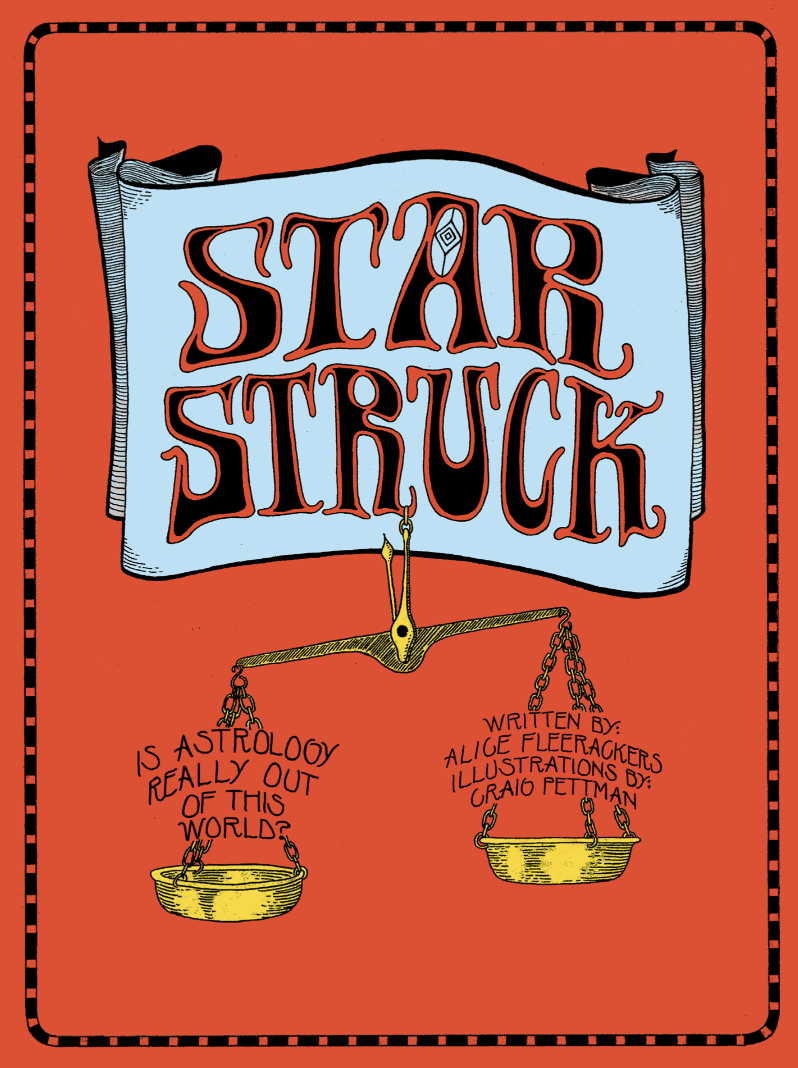
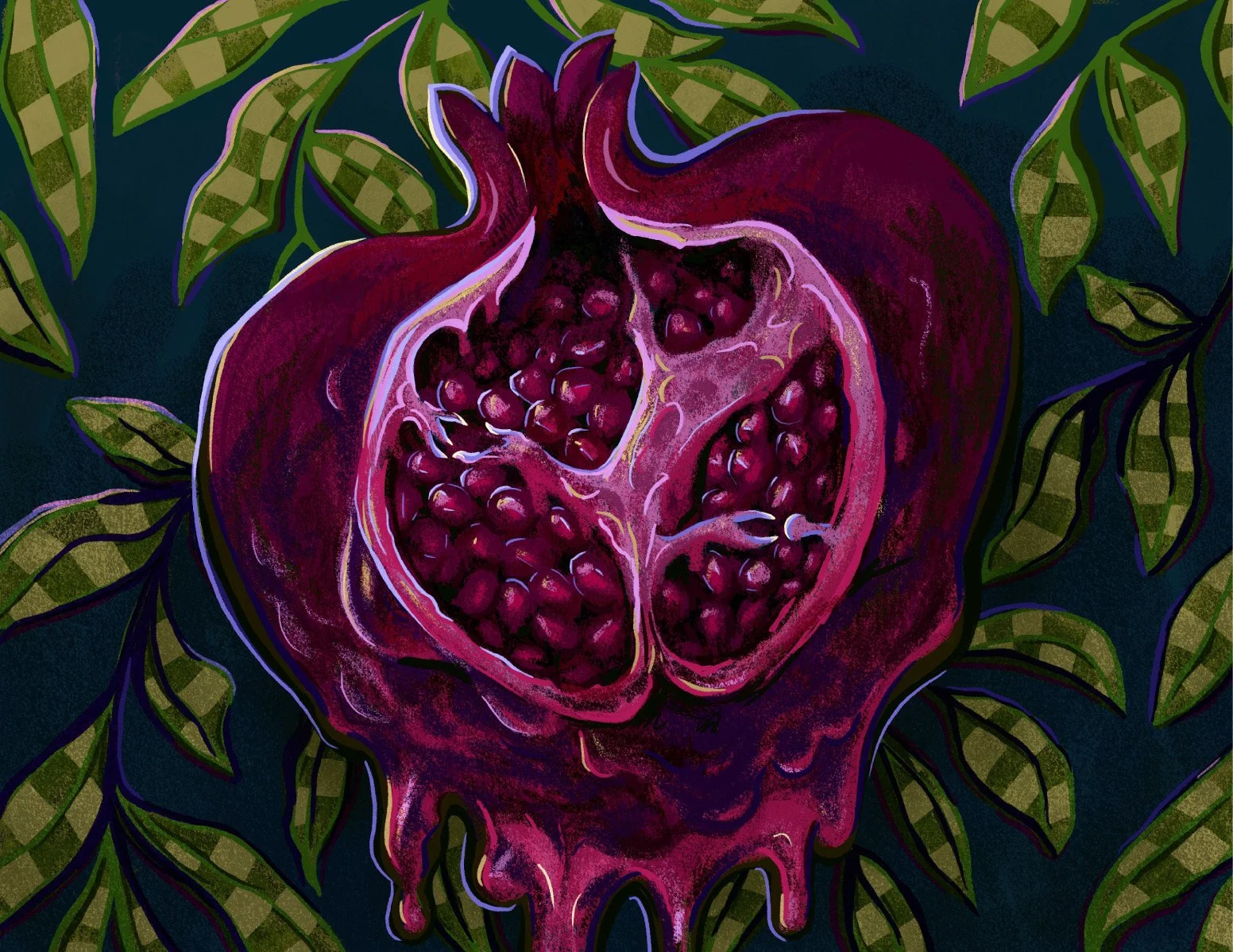
illustration by craig pettman for Sad issue 24: space
If you have ever looked to the stars for advice— perhaps even watched one too many ‘this is what your star sign says about you’ videos, like me– you are bound to take something from Alice Fleerackers’ “Star Struck”. Published in SAD’s 24th Issue: Space, “Star Struck” was written by Fleerackers before her career took her all the way across the pond to Amsterdam, where she currently resides as a journalism researcher and professor. While many still view astrology as an otherworldly craft that lacks the painstaking precision of science, Fleerackers’ conversation with renowned astrologist Georgia Nicols sheds light on exactly how much work goes into crafting a prediction— using everything from high school math to high tech forecasting software. “Star Struck” also brings up an important point, and that is that astrology was never intended to simply label people, making them into two-dimensional archetypes of themselves. Rather, it encourages people to stop and consider what a prediction means in their own lives. As an Aries, for example, I am constantly reminded of the potential that impulsive behaviour has to mess up my plans. Somehow I don’t think that applies to me, though.
Reading Alice’s piece, I had a deep appreciation for her thorough approach as an academic, particularly as she has plenty of experience fighting the allegations often made against astrology by fellow scholars. While we may joke, there is real value in the uplifting and insightful messages of a good prediction, and who could be a better messenger than a journalist with years of scientific research under her belt?
Star Struck
Is Astrology Really Out Of This World?
Words by Alice Fleerackers
Illustrations by Craig Pettman
“Oh my god, you’re a private person!” exclaims the voice on the other end of the line. “Nobody knows anything about you. Would you say that’s true?”
I grimace, but find myself nodding. This is something I’ve been hearing all my life. “And I bet you have a big grin,” she continues, with growing confidence. “Do you have a big grin?” It’s as if she can hear me smiling from her home in Bowen Island.
I’m about 10 minutes into what is quickly becoming the strangest and most personal interview I’ve ever conducted. On the phone is Georgia Nicols, an internationally renowned astrologer who writes horoscope columns for the National Post, the Province, Elle Canada, among other outlets. She’s supposed to be explaining the difference between a horoscope and a natal chart reading to me; instead, she seems to be revealing some of the most deep-rooted aspects of my personality.
I originally approached Nicols after reading a 2014 lecture by psychologist Glenn D. Wilson about cosmic influences on human behaviour. Through that, I learned that astrology’s popularity is on the rise, especially among young people. Surveys report that a shocking 25 per cent of Americans believe in horoscopes—a number that is more than twice as high among 15- to 18-year-olds. In an age when traditional religious beliefs and church congregations are dwindling, this struck me as odd. Why, I wondered, do so many of us turn to the stars for guidance? What is astrology meant to achieve? And how, ultimately, does this affect those who believe in it? Intrigued, I turned to three experts to find out, starting with Nicols.
“I would like to think that in some way, by reading me daily and weekly and annually, [people] can get a better handle on their lives,” she explains when I ask her about her columns. “I like to think that I can ... help them believe in their future.” Horoscopes, she thinks, provide value in many ways: by helping us to better understand ourselves and those around us, by guiding us away from bad decisions, and, most importantly, by offering encouragement. “Sometimes we can become paralyzed by the negative,” Nicols sighs. “It’s important to give people hope and an affirmation about their own life.”
Toby Alberin, another local astrologer, agrees: “I think astrology makes you feel like everything’s okay, that you are in the right place in the right time,” he says. Through his business, Vancouver Astrology, he provides personal readings to a variety of clients in the city, who come to him for advice about everything from love to travel to careers. Like Nicols’s columns, Alberin’s readings rely on the positions of the planets and stars to offer insights about the past, present, and future. But unlike horoscope columns, which are meant to apply to a wide swath of the population, these predictions are tailored to the individual using his or her exact time, place, and date of birth.
At the heart of this approach lies something called a natal chart, which Alberin poetically describes as a “blueprint” of a person’s potential—an astrological map of core values, behavioural patterns, and opportunities for growth. Simply put, the natal chart “describes the type of person you are and the type of person you’re not,” as well as the person who, one day, you might become.
In addition to his private practice, Alberin also teaches regular workshops in downtown Vancouver, where aspiring astrologers can develop their skills and learn new forecasting methods. I attended one of these sessions— an introduction to an approach called “primary directions”—where I witnessed the natal chart in action. Using a mix of high school math, Wikipedia biographies, and high-tech forecasting software, Alberin showed us how Jupiter’s position at the time of Margaret Atwood’s birth could be used to predict her Prometheus Award nomination 48 years later; how the moon in local athlete Ross Rebagliati’s chart seemed to indicate that he would eventually make it to the BC Sports Hall of Fame; and how Mercury’s position at Leonard Cohen’s time of birth appeared to signal his father’s death in 1944. Throughout, Alberin referenced the movements and positions of other planets and orbits and what they might signify, highlighting how very different forecasting approaches can often be used to reach strikingly similar conclusions. All of it was incredibly complex and highly technical.
Clearly, the practice of astrology involves a great deal of scientific precision, and perhaps this is why so many of us put our trust in it. But as Alberin says, any good reading also incorporates a significant intuitive component. “It’s got to be 50-50,” he asserts. It’s not enough to just identify the symbols; astrologers also have to be able to listen to their clients and develop narratives that make sense in the context of their own lives. This tender balance between intuition and science remains controversial, even among astrologers. “There are some people who want to prove that astrology is a science,” Alberin says with a shrug, “but there are some people who would say, ‘If they prove it as a science, I don’t want to do it anymore.’”
This tension between science and intuition brought me to Patty Van Cappellen, a psychologist at Duke University in North Carolina who studies the influence of religion and spirituality on human behaviour. In 2016, she and her co-authors Magali Clobert, Marianne Bourdon, and Adam Cohen published a paper about the everyday impacts of reading your horoscope. But rather than focusing on whether the events predicted by a person’s star sign can actually come true, Van Cappellen wanted to find out how the experience of reading a horoscope can affect a person’s daily life. She wondered: can reading these forecasts change the way we think, work, and feel?
She found that, compared to participants in a “neutral control condition,” people who read positive horoscopes at the beginning of the experiment were more likely to interpret ambiguous situations in a positive way later on. Even more surprisingly, reading the positive horoscopes also seemed to lead to better cognitive performance and increased creativity. “Once we have certain expectations,” she explains, “we actually make them happen.” So just as being told that you’re bad at math can cause your grades to plummet down the line, it seems being told “there’s luck ahead for Leos” might actually increase your likelihood of enjoying the day.
So what does this mean for us? Van Cappellen is cautious to jump to conclusions, explaining that the effects she witnessed were relatively small and temporary, as is often the case in psychological research. “To be honest, [these were] very short term effects,” she says. “In real life, there are so many other things happening between when you read your horoscope and the next task.” Despite these limitations, Van Cappellen urges us not to shrug the findings off. “Even for people who really don’t believe in horoscopes, this is interesting,” she explains. “Because just reading them had an influence.” She hopes her study can help people “realize that how we feel and what we achieve can be influenced by things that are out of our control.”
Personally, when it comes to applying these findings to real life, I’m inclined to take Nicols’ approach: “Read them all!” she laughs. “Because you never know. Several times throughout the year, a horoscope can hit you right on. It is possible.”
illustration by craig pettman for sad issue 24: space
Kirsten Danae: Conducting an interview over the phone presents its own set of difficulties, but you seem to have established an instant rapport with Nicols over the phone. What are your top tips for a successful interview, and do you adjust your approach according to the subject?
Alice Fleerackers: Well, it’s pretty easy when you get to speak with someone as open and warm as Nicols. It’s a long time ago now, but, from what I remember, she’s the one that made me feel at ease— and not the other way around.
But generally speaking, I like to approach interviews by remembering that they are ultimately just conversations, and that conversations are fundamentally about people connecting. So I try to be myself. I react to what people say. I express my emotions as I feel them, share my own experiences with the topic, and ask real questions as they come up during our discussion.
Also, (authentic) small talk is key. I’ve found that spending as little as two minutes at the beginning of an interview to ask about the cat crawling over the person’s keyboard or to check in on how their day is going can make a big difference for how the conversation flows during the rest of the interview. Key caveat here: you have to authentically be interested. People don’t like talking to fake humans!
Of course, all this advice only makes sense if you know the person you’re interviewing has time for it. So book interviews long if you can. If you can’t, and your source just has 15 minutes, cut to the chase.
KD: Though astrology has become increasingly popular, there are many people who still question its credibility. Why is astrology important to you and did Nichols influence your opinion?
AF: I started a PhD in science communication shortly after writing this article, and my supervisor HATED the fact that I was obsessed with horoscopes. I can still hear the exasperation in his voice when I would bring them up: “But you’re a scientist, Alice!” (He is a Taurus, clearly).
When it comes down to it, I don’t really believe horoscopes tell us the future. But, to me, that’s never really been the point of them, anyway. I love horoscopes. They are funny, they bring me joy, and they are great conversation starters. One of my favorite ways to get to know someone is by asking them about their start sign— not because the sign itself is going to reveal who they are, but because the way someone talks about their sign often does. It’s amazing how much even people who are highly skeptical of horoscopes have to say if you ask them whether they feel like a Cancer.
KD: It’s been a few years since this piece came out so I’m curious, what has your professional journey looked like since?
AF: After writing this story, I took a job in book publishing for a while, left it to freelance full-time, then started my PhD at Simon Fraser University. That degree turned into a postdoctoral fellowship at the University of British Columbia, which turned into my current role as an Assistant Professor at the University of Amsterdam, where I teach and research journalism, I also still write creatively sometimes, but now identify as an “occasional” freelance writer, penning a story or two a year, whenever I feel inspired.
Interestingly, if I look back at the years I spent writing stories like “Star Struck” for SAD Mag, I realize those experiences played a key role in shaping what I do today as a scholar. My current research focuses on how journalists act as bridges between science and society, bringing interesting findings (like the ones from Van Cappellen and colleagues’ study) into the public sphere. I think this is one of the most important roles journalists can play. Academics study so many amazing things, but very few of us get to hear about them.
KD: In your piece, you quote psychologist Van Cappellan urging people not to shrug astrological findings too quickly. Has there been a particular horoscope that has stuck with you? Do you think more creatives should listen to the stars?
AF: A few years ago, I found this amazing 70s astrology book in a box of free stuff while biking around Commercial Drive. The description of my sign (Capricorn) has stayed imprinted in my mind. Apparently, I have the personality of “a wet blanket.” While I would like to think it’s not true, these words have inspired me to stop being so serious all the time (which is not always easy as an academic!).
So, should more creatives embrace astrology? I guess it comes down to how you think about the stars. If it makes your day a bit brighter, then, yes, absolutely. But if you’re not into horoscopes, that’s fine too. The years I’ve spent arguing about it (with a Taurus, no less) have taught me that horoscope appreciation can’t be forced. Everyone needs to find their own joy— be it in the skies or elsewhere.
Alice Fleerackers is an Assistant Professor of Journalism and Civic Engagement at the University of Amsterdam, with over 10 years of freelance writing experience for magazines like SAD and other outlets such as Open Notebook, Globe and Mail and the National Post. For more cool work like this, check out her webiste alicefleerackers.com.