Very Vancouver: An Interview with Christopher Cheung
/
Christopher Cheung is curious about the stories we tell about Vancouver. He should be, considering he spent over a decade as an award-winning journalist unpacking commonly-held narratives about the city. Beneath it all, Cheung’s writing asks important questions: What stories make a city? And who gets to decide which stories matter?
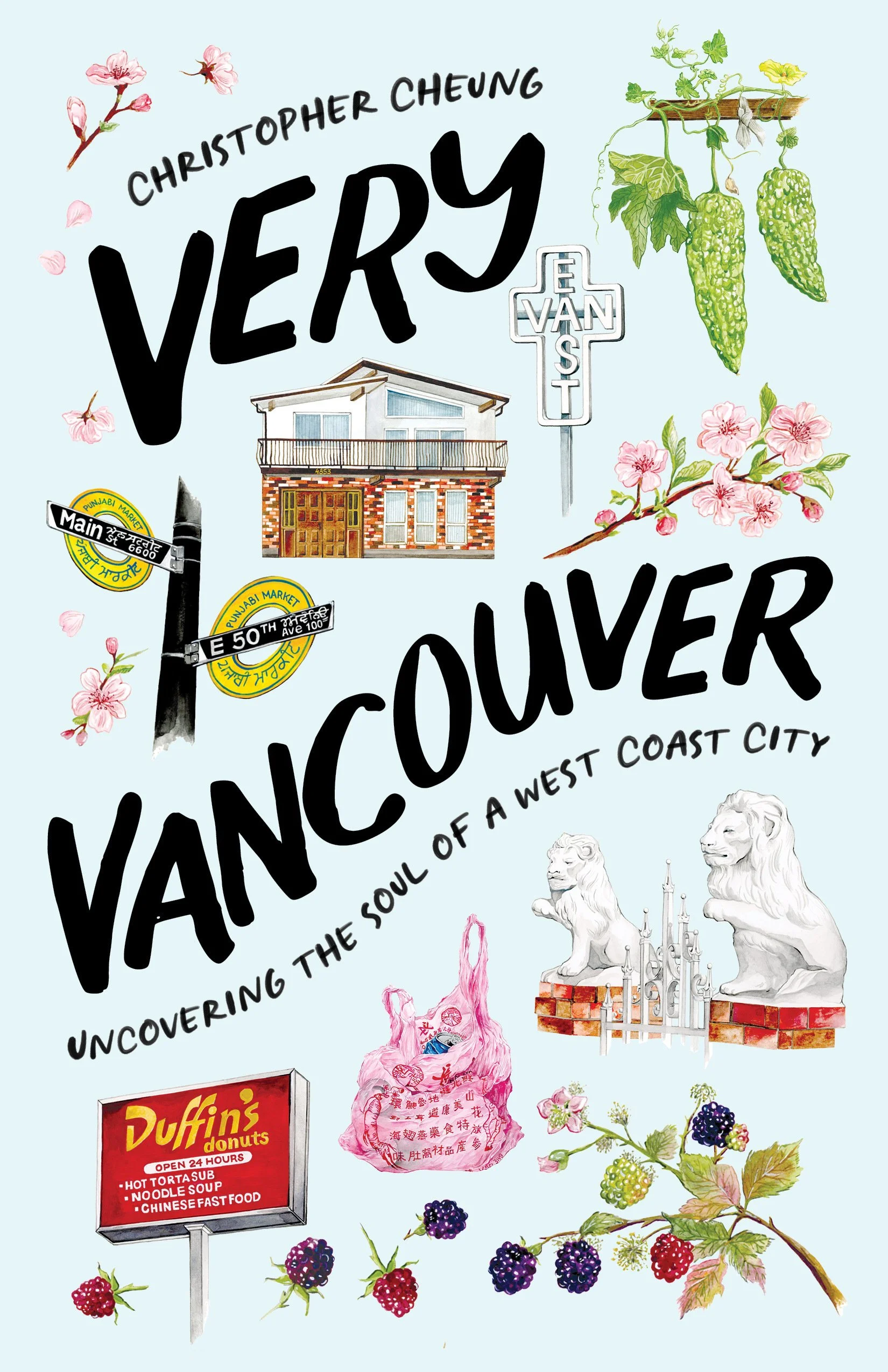
Now an instructor of journalism at BCIT, Cheung’s second book Very Vancouver: Uncovering the Soul of a West Coast City is a warm, insightful and critical expansion of his work as a journalist. Through delightfully descriptive and endearing mosaics of human-interest, reporting and investigative pieces, the book spans generations, revealing the complexity of a place that is so often reduced to glossy, reductive stereotypes.
“Just think about the brands that come out of here. It’s Aritzia, it’s Lululemon, it’s Arc’teryx. All of those really speak to one vision of Vancouver, right?” Cheung said in an interview with SAD Mag. “It’s not that this vision that people put out of the city isn’t real—it is real. But there’s also another one.”
Through fifteen stories, Cheung introduces us to Vancouver characters—some new, others familiar. There’s the intergenerational origin story of Benny’s Market in old Strathcona, the political mysteries of the Baklava man who frequented Metrotown, a day in the life of Liang Popo, who scours the streets for refundable cans and bottles, and more. Interspersed throughout are glimpses into Cheung’s career as a journalist and his ongoing passion for stories that rarely make it into mainstream reporting.
On a particularly sweltering summer afternoon, I was lucky enough to roam around South Vancouver with Christopher Cheung. We strolled neighbourhoods where he gained inspiration for stories in the book, and shared steaming soup dumplings, thinly sliced beef rolled in sweet hoisin sauce and peanut noodles at a local spot he frequents. We talked about his relationship with nostalgia in writing, the misleading narratives that circle Vancouver and the stories we miss in the process.
This interview has been edited and condensed for clarity.
Jeevan Sangha: Can you tell me about your relationship with nostalgia? How does nostalgia inform your writing?
Christopher Cheung: I think it’s easy for people to fall into nostalgia as an aesthetic, surface-level thing.
Nostalgia does tug on people’s heartstrings in this book, and I think it’s because there are a lot of layers. There’s a lot of lived experience. There are a lot of shared memories, and sometimes those shared memories have themes of immigration and family. Despite where people might be from, they’re like, “Oh my god, I remember when my grandparents were raising me, and I grew up with people who had that same kind of experience.”
A lot of what people love about the city is expressed [through] shared memories. It’s the things that are old, that we have memories of, and we start to appreciate now. There are a lot of new visions of Vancouver, right? FIFA just ended. Whenever there’s [a major event like] the Olympics or Expo, there’s an image of Vancouver that is projected on the world stage. And it’s usually the shiny one. It’s about development. It’s about a shallow version of diversity, blah, blah, blah.
But those visions, they miss what [Vancouver] is really about, right? Something that’s more grounded, something that’s a bit more local. So I hope that [local] people feel the book is affirming, or that they learn something new about the city.
JS: Tell me a bit about how much of that is informed by the way you’ve approached journalism throughout your career. It feels very present and community-engaged. How did that practice form for you?
CC: I think some journalists are comfortable being what’s been called ‘the parachute journalist,’ where they go in and out [of a community], collect the story, get the interview, and that’s it. At the end of the day, that’s all they do and they just move on to the next one. Another kind of person might say, ‘I want to take my time. I want to get to know this person. I want to be able to talk to them for an hour or so.’ Especially if you’re writing about a place that you know, or a business that you’re really familiar with.
So, if you’ve been eating the Kim family’s beef balls or Sunrise Tofu all your life, when you sit down to do that interview, it’s different than if you were to just be like, ‘Oh, tell me about tofu.’
You can ask a [different] question, like, ‘Oh, you’ve been doing this for so long! I’ve eaten your stuff all my life. What do you think about what you’re doing? How does that matter to the city?’
JS: I think there’s something special about having someone feel seen for their work, too. That can be a really powerful moment.
CC: The other day somebody asked me, “How do you have those kinds of deep interviews?” And I think if you get what a person does and what they stand for, that really helps.
JS: I loved the anecdotes throughout the book about your parents and the gifts that you would receive through food—whether it was through your dad from the seniors in the community who he supported as a pharmacist, or your mom as a piano teacher. What do gifts and food say about what we value in a community?
CC: My childhood felt super social. It wasn’t just our family, but all these other families that we were connected to. Having food as a metaphor for that was really special, especially since it’s something that’s homemade. It felt like there was somebody who had this whole tradition. It had a lot of history with them in their family. You get to be a part of it even though you weren’t a part of it before.
We realized we weren’t alone. We were living with a lot of people in the city. When we’d go out we would run into people that my dad knew. It was a very warm thing to think about, that spirit of generosity and welcoming people in. It wasn’t even about eating the most delicious thing in the world. It was sometimes very mediocre, even bad. But that gesture, it means a lot. Even now, whenever I get to partake in that, I feel very lucky.
JS: I feel like I had a version of that today, [being] invited into the places that you like to eat.
CC: Laughs. Yeah, that’s true.
JS: Talk to me about including the vignettes about your career as a journalist. What was the decision like to include those pieces?
CC: In talking about nostalgia and what’s authentic about the city, you have to think about who’s writing these narratives, right? Who gets to decide what Vancouver is? My perspective [as a journalist] is going to be very different.
When I see the stuff that portrays the Vancouver that I think is shallow, or erases experiences that I know to be at the heart of this place, it’s important to show the behind the scenes. It’s like asking the reader, ‘Why don’t you come to see how these visions get constructed?’
There’s a moment in the book where I was part of a newsroom where there was somebody who covered every beat. And then, within a year, that wasn’t the case anymore. I could literally see media dying in front of my eyes. I want people to know that there is something that’s on the decline here.
JS: What’s one thing you want people to know about Very Vancouver?
CC: I think there is an important aspect of class analysis with this book. Sure, Vancouver’s ranked as one of the most livable places in the world. But we also rank as the most unaffordable. How do we reconcile that? And I don’t think we talk about that other side of things enough.
In the last story, there’s a man named Steve who really wants to stay in his neighbourhood. He’s lived in hostels. He’s slept under this bridge. After his SRO had a fire, he constantly went back to sweep the front corridor because he wanted to go back. He really represents a lot of people who are fighting to stay here. When we’re talking about our struggle to stay in the city, I don’t want to forget about the people who are fighting tooth and nail to stay here.
You know, there aren’t a lot of books about Vancouver, but there are some. And they cover the same kinds of places. It’s Gastown, Yaletown, Kits, Mount Pleasant. If there’s some diversity, it’s gonna be Chinatown and the Punjabi Market. Even for books that claim to be more in-depth, they depict a very sanitized version of the city.
Honestly, there’s some pretty upsetting things in this book. Older people doing tough, physical labour, and parents not talking to their children for years. I think it’s important to be honest about those kinds of things even though it is hard to talk about. So I would hope that this feels like an anti-tourism book or an anti-guide to Vancouver. It’s more about trying to understand the city on a different level and hopefully inspire more curiosity.
To learn more about Christopher Cheung’s latest book Very Vancouver: Uncovering the Soul of a West Coast City, visit ecwpress.com.
Jeevan Sangha is a culture writer, editor, and freelance journalist born and raised in Surrey, BC. She explores the intersection of media, politics, and culture—with a specific passion for covering the Punjabi-Canadian experience. Jeevan is currently a senior editor at shado Magazine, and you can find her words in publications like CBC Music, Billboard Canada, The Tyee and more. You can find her on Instagram @jeevanksangha.